
Pleomele (Dracaena reflexa)
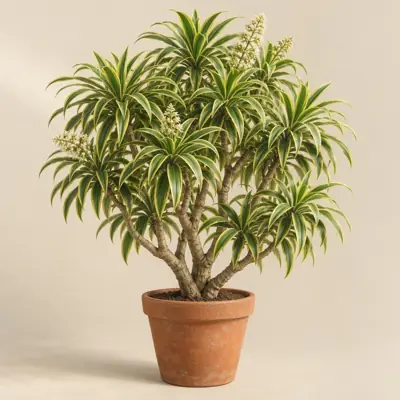
Dracaena reflexa is a perennial evergreen tropical shrub to small tree with upright growth; it can form a main trunk with sparse or multiple branching and is usually smaller indoors.
Overview
Dracaena reflexa is a perennial evergreen tropical shrub to small tree with upright growth; it can form a main trunk with sparse or multiple branching and is usually smaller indoors.
Origin and habitat
Sources differ on the native range, describing southwestern Indian Ocean areas including Madagascar, Mauritius, Réunion, the Comoros, and the Seychelles, as well as northeastern Mozambique on mainland Africa. It is reported to grow naturally in several types of forest, including shaded understory sites, with branches able to extend toward brighter positions. It is reported to be a tropical plant whose native area lies mainly on Indian Ocean islands and in Mozambique.
Characteristics
Sources differ on mature height, placing it at about 150–250 cm, while a single source reports a mature spread of about 10–50 cm. It is generally described as slow-growing, with simple, leathery to glossy, narrowly lance-shaped to elliptic-lance-shaped leaves arranged spirally along the stems and crowded toward branch tips; the leaves have parallel veins and entire margins, and the typical species form usually has dark green leaves. Sources differ in describing the small flowers as white to greenish white or yellow-green; they occur in clusters or branched inflorescences, and mature indoor plants sometimes flower, with one source reporting flowering in midwinter. The plant develops small berry-like fruits when mature, but sources differ on mature fruit color, describing tones from bronze to orange-red; a French-language source also reports that the fruits contain seeds.
Light
Sources differ somewhat, but describe bright light to bright indirect light as suitable, with partial shade tolerated and shade needed under hot, intense sunlight; very low light may allow survival but can produce weak, elongated growth.
Watering
Sources differ somewhat on watering: during the growing season, water moderately and keep the growing medium moist but well drained, allowing the surface to dry slightly before watering again; reduce watering in winter, and the plant can tolerate periods of less frequent watering.
Humidity and airflow
It is generally reported to prefer moderate humidity.
Temperature and dormancy
A single source places the ideal temperature at about 18–25 °C, with reported lower and upper bounds of about 18 °C and 25 °C. USDA and RHS hardiness classifications are reported for the plant. It is generally described as frost tender; keep above freezing.
Growing medium and mounting
It is reported to suit loamy or sandy, moist but well-drained growing media; containers can use a loam-based, peat-free potting medium, and acidic, neutral, or alkaline conditions are tolerated.
Feeding
Sources differ on feeding details, but describe regular applications of a balanced liquid fertilizer during the growing season.
Propagation
It can be propagated by stem cuttings; RHS also reports propagation from seed in spring or by semi-ripe cuttings from late spring to early summer, with bottom heat sometimes needed for rooting.
Common problems
Scale insects may affect the plant, while genus-level Dracaena information also lists mealybugs, thrips, and scale insects as potential problems. Insufficient light can lead to weak growth, and genus-level Dracaena information indicates possible sensitivity to salts, chlorine, and fluoride in tap water, with browning of leaf tips. Warm, sheltered conditions are preferred, with frost avoided and shade provided under hot, intense sunlight. It is generally reported to have few disease problems.
Identification
Dracaena reflexa can be recognized by upright, relatively thick and sometimes irregular stems, narrow evergreen leaves densely clustered in a whorled-looking arrangement at branch tips, and slow overall growth.
Photos


Sources
- Wikipedia (en): Dracaena reflexa — CC BY-SA 4.0 · link
- Wikipedia (de): Dracaena reflexa — CC BY-SA 4.0 · link
- Wikipedia (fr): Bois de chandelle — CC BY-SA 4.0 · link
- Wikipedia (es): Dracaena reflexa — CC BY-SA 4.0 · link
- GBIF descriptions: Lista de especies de plantas exóticas y trasplantadas de Colombia; Catálogo de Plantas y Líquenes de — per dataset · link
- RHS Plants: Dracaena reflexa — © RHS, facts only · link
- USDA PLANTS Database: Dracaena reflexa — Public domain (US Government work) · link
- NC State Plant Toolbox: Dracaena (genus-level) — copyright (facts only) · link