
viper's bowstring hemp (Dracaena trifasciata)
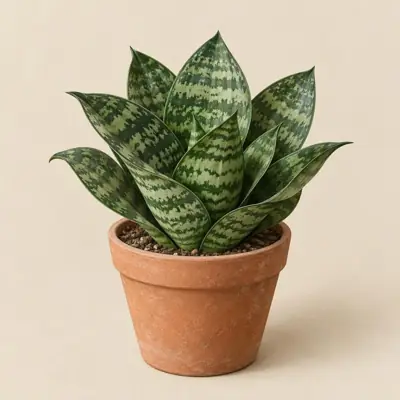
Dracaena trifasciata is an evergreen, perennial, clump-forming tropical herb that grows from creeping rhizomes; 'Hahnii' is a dwarf cultivar with a distinct rosette form.
Overview
Dracaena trifasciata is an evergreen, perennial, clump-forming tropical herb that grows from creeping rhizomes; 'Hahnii' is a dwarf cultivar with a distinct rosette form.
Origin and habitat
Sources differ on its native range, describing tropical to central Africa with the core range around Nigeria to Congo. It is reported from dry areas of Africa and is described as adapted to drought. It occurs in tropical to subtropical conditions, tolerating dryness and lower light but not cold or prolonged excessive moisture.
Characteristics
Sources differ on mature height, placing it at about 20–25 cm, while limited sourcing reports a mature spread of about 10–50 cm. 'Hahnii' has overlapping, outward-spreading leaves that form a clear rosette, with gray-white to gray-green transverse markings; the species has thick, firm, succulent leaves that store water. Growth is relatively vigorous, with offsets continuing to form clumps. It can produce small tubular flowers that range from pale greenish white to creamy white, may have a sticky texture, and can be fragrant, although flowering is uncommon indoors; sources differ on flowering season.
Light
It accepts bright light or part shade and tolerates low light; ample light is suitable in cultivation, while strong direct summer sunlight should be avoided in glasshouses.
Watering
It is drought tolerant; allow the potting medium to dry before watering during the growing period, avoid prolonged excessive moisture or frequent watering because these can lead to root rot, and keep it considerably drier during winter.
Humidity and airflow
It is generally reported to prefer low humidity and need good airflow.
Temperature and dormancy
Limited sourcing suggests a minimum temperature of about 10 °C. It is generally reported to rest in winter and to tolerate heat well.
Growing medium and mounting
It needs a well-drained medium and can be grown in loamy or sandy media. It is prone to rot and needs a fast-draining mix.
Feeding
During active growth, slow-release chemical fertilizer or liquid fertilizer is reported to be suitable at intervals.
Propagation
It can be propagated by division, offsets, or leaf cuttings; division preserves the parent plant's characteristics, while variegated forms propagated from leaf cuttings may lose their original markings.
Common problems
Possible pests include scale insects, aphids, thrips, mealybugs, and weevils. Damping-off may occur, and prolonged excessive moisture can also cause root rot. Overwatering is a major problem and can cause root rot, yellowing or whitening of leaves, collapse, and even plant death, while insufficient light can make leaves weaker. It tolerates drought and heat but is sensitive to low temperatures and wet winter conditions; cold can cause leaves to collapse and die.
Identification
'Hahnii' is a representative dwarf form of Dracaena trifasciata, with short overlapping leaves forming a compact, bird's-nest-like rosette rather than the tall, upright, sword-shaped form typical of the species.
Photos


Sources
- Wikipedia (en): Dracaena trifasciata — CC BY-SA 4.0 · link
- Wikipedia (ja): サンセベリア — CC BY-SA 4.0 · link
- Wikipedia (de): Dracaena trifasciata — CC BY-SA 4.0 · link
- GBIF descriptions: Especies introducidas, exóticas, trasplantadas, invasoras y potencialmente invasoras obtenidas a par — per dataset · link
- NC State Plant Toolbox: Dracaena trifasciata — copyright (facts only) · link
- Wikipedia (nl): Dracaena trifasciata — CC BY-SA 4.0 · link
- Wikipedia (pt): Dracaena trifasciata — CC BY-SA 4.0 · link
- RHS Plants: Dracaena trifasciata — © RHS, facts only · link
- NHK みんなの趣味の園芸 植物図鑑: Dracaena (genus-level) — © NHK出版, facts only · link