
viper's bowstring hemp (Dracaena trifasciata)
Dracaena trifasciata is a perennial evergreen, upright, clumping, succulent herb with creeping rhizomes, with leaves growing upright from the base or rhizomes.
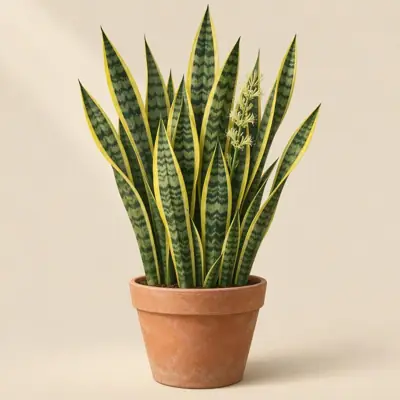
Overview
Dracaena trifasciata is a perennial evergreen, upright, clumping, succulent herb with creeping rhizomes, with leaves growing upright from the base or rhizomes.
Origin and habitat
Sources differ in describing its native range, placing it broadly in tropical to central Africa and specifically including the region from Nigeria to the Congo. It is reported to occur mainly in dry areas of Africa. It is a tropical plant adapted to dry conditions and can be grown outdoors in warm regions, while in colder regions it is mainly grown indoors.
Characteristics
Sources differ on mature height, with the few available accounts placing it at about 100–150 cm; its mature spread is reported to be about 10–50 cm, based on few sources. It is reported to grow relatively slowly, producing new leaves mainly from spring through summer. Sources differ in their descriptions, but the leaves are stiff, upright, and sword-shaped to linear-lanceolate, with paler gray-green to light-green crossbands on a dark-green surface; 'Laurentii' is distinguished by yellow margins along both sides of the leaves. The small, tubular, pale greenish-white to creamy-white flowers arise in inflorescences among the leaves, may be sticky, and some are fragrant; sources differ on flowering season, while flowering indoors is rare, and the plant stores water in its leaves.
Light
It accepts bright filtered light, partial sun to sun, and can tolerate very low light; cultivation favors ample light, though strong direct summer sun should be avoided in glasshouse conditions. It takes full sun.
Watering
It tolerates drought; from spring through autumn, allow the growing medium to dry before watering and avoid prolonged wetness and overwatering, while watering should be greatly reduced in winter and may approach withholding water under cold conditions. The stated winter watering interval is 30–60 days.
Humidity and airflow
It is generally reported to prefer low humidity and need good airflow.
Temperature and dormancy
Sources differ on the lower temperature guidance, with few sources placing it at about 10 °C, while a separate limited account gives a cold minimum of about 5 °C. It is frost tender; keep above freezing, and it generally rests in winter. It is reported to tolerate heat well, although intense direct sun in midsummer may scorch the leaves.
Growing medium and mounting
Use a well-drained growing medium; loamy or sandy media are suitable, and container-growing information also recommends a well-draining granular medium. It is prone to rot and needs a fast-draining mix.
Feeding
During the spring-to-autumn growing period, slow-release chemical fertilizer or liquid fertilizer is reported to be applied periodically.
Propagation
It can be propagated by division, offsets, or leaf cuttings. For variegated forms such as 'Laurentii', plants from leaf cuttings may lose their variegation, so division is more suitable when the yellow margins need to be maintained.
Common problems
Possible pests include scale insects, aphids, longtailed mealybugs, greenhouse thrips, and weevils. Disease problems are generally limited, but overwatering can cause root rot and is the main cultivation risk. Cold can damage leaves and cause them to collapse or die; the plant can survive low light, though some horticultural sources report that its leaves may become weaker or more prone to collapse. It tolerates heat and drought but is sensitive to low temperatures and excessive winter moisture; outdoor cultivation should use a frost-free, relatively protected location.
Identification
Sources differ in their descriptions, but 'Laurentii' broadly retains the upright, sword-shaped leaves and alternating dark and light green crossbands of the species, with conspicuous yellow margins on both sides of each leaf and more regular crossbanding on the leaf surface.
Photos


Sources
- Wikipedia (en): Dracaena trifasciata — CC BY-SA 4.0 · link
- Wikipedia (ja): サンセベリア — CC BY-SA 4.0 · link
- Wikipedia (de): Dracaena trifasciata — CC BY-SA 4.0 · link
- GBIF descriptions: Especies introducidas, exóticas, trasplantadas, invasoras y potencialmente invasoras obtenidas a par — per dataset · link
- NC State Plant Toolbox: Dracaena trifasciata — copyright (facts only) · link
- Wikipedia (nl): Dracaena trifasciata — CC BY-SA 4.0 · link
- Wikipedia (pt): Dracaena trifasciata — CC BY-SA 4.0 · link
- RHS Plants: Dracaena trifasciata — © RHS, facts only · link
- NHK みんなの趣味の園芸 植物図鑑: Dracaena (genus-level) — © NHK出版, facts only · link
- サンスベリアの育て方|枯らさない水やりと冬の断水、人気の品種と増やし方 (greenlifelab.net) — facts only (§12) · link
- サンスベリアの育て方|枯らさない水やりと冬越しのコツ【初心者向け】 | 観葉ラボ (kanyo-labo.com) — facts only (§12) · link