
Australian sundew (Drosera aliciae)
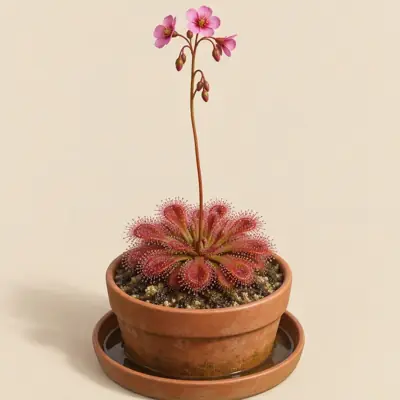
Drosera aliciae is a perennial carnivorous herb that forms tight basal rosettes and can develop into clustered, mat-like growth when mature.
Overview
Drosera aliciae is a perennial carnivorous herb that forms tight basal rosettes and can develop into clustered, mat-like growth when mature.
Origin and habitat
Drosera aliciae is native to South Africa, ranging from the southwest to the east and including the Cape region. It is reported to favor sunny, moist environments and can grow in moist sandy ground, mossy settings, and peat substrates. Its native environment is reported to have a mild climate.
Characteristics
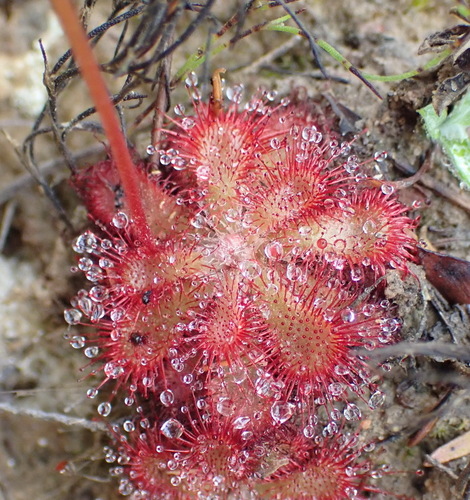
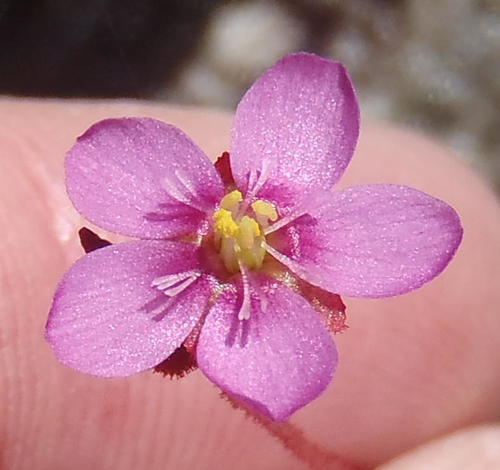
Few sources report a mature height of about 0–10 cm. Sources differ on mature spread, with a reported range of about 10–50 cm. Sources differ in their descriptions: the sessile, spoon-shaped to wedge-shaped leaves form a tight rosette and bear sticky glandular hairs that trap insects; in strong light, the leaves or tentacles may turn orange-red to deep red, while the pink to purplish-red flowers are borne on upright inflorescences above the trapping leaves, and flowering-season accounts also differ. It is reported to grow and reproduce readily and may self-sow; its fruit is reported to be an ovoid capsule containing many small, elongated spindle-shaped seeds.
Light
Drosera aliciae favors full sun to very bright conditions, although greenhouse plants may need moderate shade around hot summer midday periods.
Watering
During the growing season, keep the medium moist to wet; tray (bottom) watering with lime-free water is suitable, and rainwater or reverse-osmosis water can be used. Use pure water only (rain, RO or distilled) and keep evenly moist. In winter, keep the medium only slightly moist rather than continuously leaving the pot standing in water.
Humidity and airflow
Few sources report suitable humidity at about 50–80 %. It is reported to need good airflow.
Temperature and dormancy
Few sources report an ideal temperature range of about 10–30 °C and a minimum of about 10 °C. It is generally described as frost tender; keep above freezing. An RHS hardiness classification is also reported.
Growing medium and mounting
An acidic medium that remains moist to poorly drained is suitable; sources mention sand and peat. A suitable substrate type is sand with peat.
Feeding
Do not fertilize; the plant can grow without supplemental feeding of insects.
Propagation
Propagation can be by seed, with sowing recommended soon after the seed matures, or by leaf cuttings during the growing season and root cuttings during dormancy. Genus-level information for Drosera also describes division as a propagation method.
Common problems
Sources differ on pests: Drosera aliciae is described as generally having few pest problems, while genus-level information for Drosera lists aphids and spider mites as possible pests. Sources differ on disease problems: the species is generally described as having few, but it may be susceptible to Botrytis. In Drosera, poor airflow may be associated with aphids, while hot, dry-air conditions may be associated with spider mites; continuously standing the pot in water during winter does not match the reported winter management guidance for this species. Avoid excessively low winter temperatures, and hot midday conditions in a greenhouse during summer may call for shade.
Identification
Drosera aliciae is distinguished by a small, tight rosette with leaves densely covered in red, sticky glandular hairs; ample light can make the leaves or tentacles markedly red, and the inflorescence rises conspicuously above the trapping leaves.
Photos


Sources
- Wikipedia (en): Drosera aliciae — CC BY-SA 4.0 · link
- Wikipedia (de): Drosera aliciae — CC BY-SA 4.0 · link
- Wikipedia (fr): Drosera aliciae — CC BY-SA 4.0 · link
- Wikipedia (es): Drosera aliciae — CC BY-SA 4.0 · link
- RHS Plants: Drosera aliciae — © RHS, facts only · link
- USDA PLANTS Database: Drosera aliciae — Public domain (US Government work) · link
- NHK みんなの趣味の園芸 植物図鑑: Drosera (genus-level) — © NHK出版, facts only · link
- NC State Plant Toolbox: Drosera (genus-level) — copyright (facts only) · link