
Cape sundew (Drosera capensis)
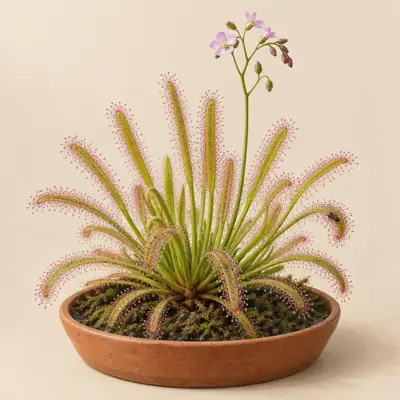
Drosera capensis is a carnivorous perennial herb that typically forms rosettes, with some forms developing a short stem as old leaves accumulate. It is perennial and is also described as an evergreen perennial.
Overview
Drosera capensis is a carnivorous perennial herb that typically forms rosettes, with some forms developing a short stem as old leaves accumulate. It is perennial and is also described as an evergreen perennial.
Origin and habitat
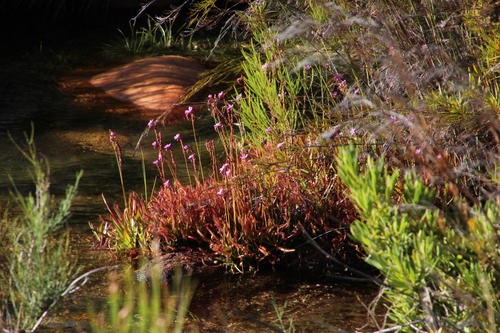
Sources differ in describing its native range in the Cape region of South Africa, principally in southwestern South Africa. It occurs in wet to persistently waterlogged, nutrient-poor environments, including marshes and areas around lakes, and favors low-mineral, non-calcareous or acidic wetland conditions. Its native Cape-region climate is reported to be mild and moist, and wild plants are reported to grow in full sun to partial sun.
Characteristics
Sources differ on mature size, with the few available estimates giving a height of about 10–50 cm and a spread of about 10–50 cm. It is reported to grow rapidly and reproduce readily in large numbers. Sources differ in details of leaf width and color among forms; the leaves are slender, ranging from linear and oblong to narrowly spoon-shaped, with distinct petioles and dense mucilage-secreting glandular hairs that capture prey, after which the leaf can bend around it. Flowers range from pink, peach-pink and magenta to pale purple, with white flowers also occurring in cultivated or natural forms; inflorescences can bear multiple flowers, and the flowers are capable of self-pollination, while sources differ on flowering season and the resulting pollinated flowers are reported to produce many small, slender or narrow seeds, sometimes described as black.
Light
Drosera capensis prefers bright light to full sun, and some sources also describe wild plants growing in partial sun; for greenhouse cultivation in hot, frost-prone areas, full light is recommended while avoiding excessively hot direct sun. Its light need is full sun.
Watering
Keep the medium continuously moist with low-mineral water; a tray of rainwater can maintain moisture, while one source recommends reducing watering and removing the tray in winter. Use pure water only (rain, RO or distilled), with tray (bottom) watering to keep wet; the plant is compatible with the tray method.
Humidity and airflow
The few available estimates report a humidity range of about 40–80 %, and the plant is generally reported to prefer moderate humidity. It is reported to need good airflow.
Temperature and dormancy
The few available estimates report an ideal range of about 5–40 °C, with a reported minimum of about 5 °C and maximum of about 40 °C. It is rated RHS H3, with protected cultivation recommended in frost-prone areas. It is reported to tolerate brief light frost. Sources differ on whether it has no dormancy.
Growing medium and mounting
The medium should remain moist and nutrient-poor, with sources recommending acidic to neutral, poorly drained wetland-like conditions; one source also gives a peat and non-calcareous sand mixture without a specified numerical ratio here. The substrate is generally reported to be sand with peat.
Feeding
It is generally reported to grow under low-nutrient conditions both in nature and cultivation and not to require ordinary fertilization for nutrient supplementation. It is generally reported to grow without needing to be fed insects.
Propagation
Drosera capensis can be propagated from seed, softwood cuttings or root cuttings; other sources also record leaf cuttings and division of rhizomes.
Common problems
It is generally reported to have few notable pests or diseases. Above-ground growth may wilt in high temperatures; sources also emphasize using low-mineral water and maintaining moisture. Sources differ in their descriptions of frost sensitivity: severe frost is unsuitable and protected cultivation is recommended where frost is a risk, although the plant is also described as able to withstand light frost.
Identification
The leaves are reported to bear glandular hairs that secrete mucilage and trap insects and other arthropods; after prey is captured, the leaf bends markedly inward, increasing contact between the prey and the digestive area.
Photos


Sources
- GBIF Backbone: Drosera capensis L. — CC BY 4.0 · link
- Wikipedia (en): Drosera capensis — CC BY-SA 4.0 · link
- 維基百科:好望角毛氈苔 — CC BY-SA 4.0 · link
- Wikipedia (ja): アフリカナガバノモウセンゴケ — CC BY-SA 4.0 · link
- Wikipedia (de): Kap-Sonnentau — CC BY-SA 4.0 · link
- Wikipedia (fr): Drosera capensis — CC BY-SA 4.0 · link
- Wikipedia (es): Drosera capensis — CC BY-SA 4.0 · link
- Wikipedia (it): Drosera capensis — CC BY-SA 4.0 · link
- Wikipedia (nl): Kaapse zonnedauw — CC BY-SA 4.0 · link
- RHS Plants: Drosera capensis — © RHS, facts only · link
- USDA PLANTS Database: Drosera capensis — Public domain (US Government work) · link
- NHK みんなの趣味の園芸 植物図鑑: Drosera capensis — © NHK出版, facts only · link