
Rosy Sundew (Drosera spatulata)
Drosera spatulata is a perennial terrestrial carnivorous herb with no conspicuous above-ground stem, forming a rosette of leaves close to the ground.
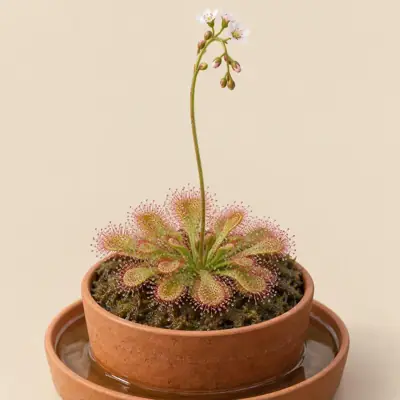
Overview
Drosera spatulata is a perennial terrestrial carnivorous herb with no conspicuous above-ground stem, forming a rosette of leaves close to the ground.
Origin and habitat
Sources differ on its native range: it is broadly distributed across the western Pacific and Asia-Pacific, including Japan, Korea, Taiwan, southern China, Southeast Asia, Borneo, the Philippines, Micronesia, Papua New Guinea, eastern to southeastern Australia, Tasmania, and New Zealand, while a French source extends the distribution westward to Sumatra and the Malay Peninsula; TaiCOL lists it as native but not endemic to Taiwan. It occurs in wet environments, and horticultural information for Drosera also describes members of the genus as commonly occurring in persistently wet environments such as marshes and peat bogs. It is reported to occur across temperate, subtropical, and tropical climates, with some localities in tropical highland environments.
Characteristics
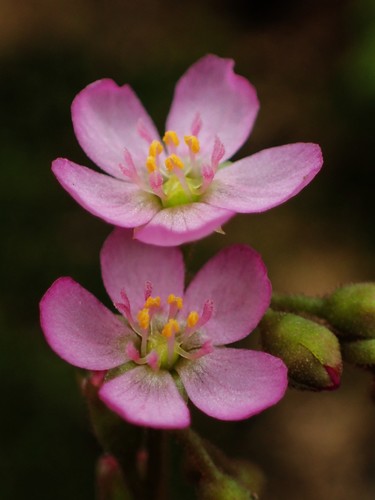
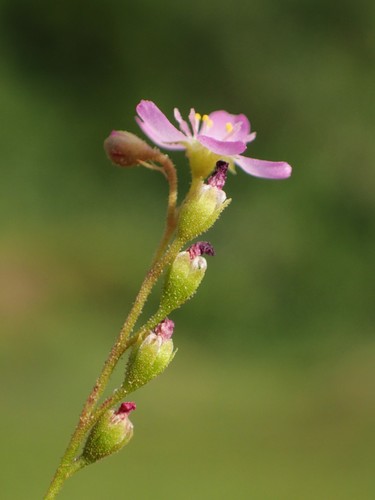
Few sources report a mature height of about 8–30 cm, while sources differ on a mature spread of about 1.5–5 cm. Growth is reported to be relatively slow, though it can increase more quickly when prey is available or conditions are suitable. The basal rosette has spoon-shaped leaves with broader tips and dense mucilage-bearing glandular hairs on the surface and margins; sources describe differing leaf dimensions, and the leaves can develop red or pink-red tones under good light. Flowers are reported to range from white and pink to pink-purple and are borne in a one-sided raceme on an upright flower stalk; sources differ on the early-summer flowering period, and the fruit is reported to be a capsule containing extremely small seeds.
Light
Drosera spatulata needs bright light, and artificial lighting can be used. Sources differ on direct sun, ranging in their recommendations from full light to partial-day sun, and plants not acclimated to direct light should have exposure increased gradually.
Watering
The medium is reported to need to stay wet, and tray (bottom) watering can be used. Rainwater, distilled water, or low-mineral reverse-osmosis water is generally recommended; low-mineral water is fine, while hard water can cause salt accumulation.
Humidity and airflow
Few sources report a preferred humidity of about 50–100 %. It is reported to prefer high humidity and need moderate airflow.
Temperature and dormancy
Few sources report an ideal temperature of about 18–28 °C, with a reported minimum of about 7.2 °C and maximum of about 32.2 °C. Drosera spatulata has no dormancy.
Growing medium and mounting
Use a low-nutrient carnivorous-plant medium without added fertilizer; sources give peat with perlite as an example, while genus-level information also recommends peat with a sandy medium.
Feeding
Avoid adding fertilizer to the medium; Drosera cultivation information generally advises that fertilizing and supplemental feeding with insects are unnecessary for growth.
Propagation
Drosera spatulata can be propagated from seed, produces seed readily, and can reproduce on its own; horticultural information for Drosera also describes division and leaf cuttings as propagation methods.
Common problems
Drosera cultivation is reported to be susceptible to aphids and spider mites, with aphids more likely under poor airflow and spider mites more likely in hot, dry conditions. No significant disease problems are reported. Hard water can cause salts to accumulate in the medium, while insufficient light can affect compact growth, mucilage production, and red coloration; suddenly exposing an unacclimated plant to strong direct light can also be a concern. It does not require winter dormancy, and commercial cultivation information provides a temperature range.
Identification
Drosera spatulata forms a compact rosette of spoon-shaped leaves whose glandular hairs secrete glistening mucilage that can trap small insects, which are broken down by digestive enzymes so nutrients can be absorbed.
Photos


Sources
- Wikipedia (en): Drosera spatulata — CC BY-SA 4.0 · link
- 維基百科:小毛氈苔 — CC BY-SA 4.0 · link
- Wikipedia (de): Drosera spatulata — CC BY-SA 4.0 · link
- Wikipedia (fr): Drosera spatulata — CC BY-SA 4.0 · link
- TaiCOL 臺灣物種名錄: Drosera spatulata — CC BY 4.0 · link
- USDA PLANTS Database: Drosera spatulata — Public domain (US Government work) · link
- NHK みんなの趣味の園芸 植物図鑑: Drosera (genus-level) — © NHK出版, facts only · link
- NC State Plant Toolbox: Drosera (genus-level) — copyright (facts only) · link
- Sundew 'Drosera spatulata var lovellae' (www.araflora.com) — facts only (§12) · link
- Drosera spatulata – Sundew, a carnivorous plant with compact rosettes – Secret G (secretgarden.ro) — facts only (§12) · link
- Drosera spatulata | Spoon-leaved sundew care & info - Houseplant Central (houseplantcentral.com) — facts only (§12) · link
- Drosera spatulata - Spoon-Leaved Sundew (joshsfrogs.com) — facts only (§12) · link