
Small round-leaf sundew (Drosera tokaiensis)
Drosera tokaiensis is a small carnivorous herb with a basal rosette, a very short stem, and leaves bearing mucilage-secreting glandular hairs that capture prey. It is reported to be a perennial herb.
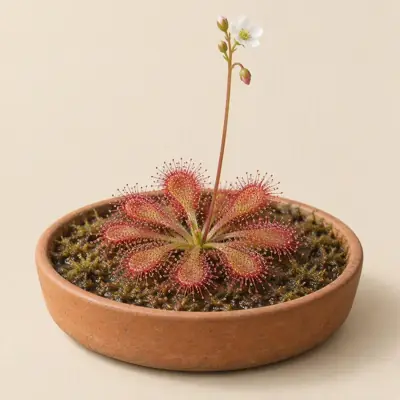
Overview
Drosera tokaiensis is a small carnivorous herb with a basal rosette, a very short stem, and leaves bearing mucilage-secreting glandular hairs that capture prey. It is reported to be a perennial herb.
Origin and habitat
Sources differ on its recorded range in Japan: it is documented from the Hokuriku, Tokai, and Chugoku regions of Honshu and from Shikoku, while records or reports from Kyushu require further examination. It is reported to grow in sunny, acidic wetlands, springs, and other moist environments, favoring wetter sites.
Characteristics
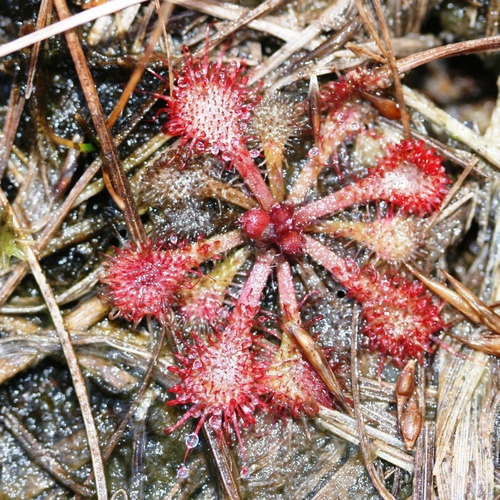
With few sources available, mature height is reported at about 10–20 cm and mature spread at about 5.08–7.62 cm. The leaves form a basal rosette and range from spoon-shaped to oblanceolate, narrowing gradually toward the base with a poorly defined petiole; their surfaces bear long, sticky red glandular hairs, and the leaves themselves may become more distinctly red under strong light. The flowers are vivid pink and are produced readily, with sepals ranging from narrowly ovate to ovate. It is reported to produce many seeds.
Light
Drosera tokaiensis is generally grown in full sun with abundant light, which supports red leaf coloration and normal mucilage formation; in very hot, dry regions, morning direct sun with protection from strong afternoon sun is reported to be suitable.
Watering
The growing medium should generally be kept wet and not allowed to dry completely, using tray (bottom) watering and pure water only (rain, RO or distilled). In winter, the medium is reported to be kept somewhat drier than during active growth while still never being allowed to dry completely.
Humidity and airflow
It is reported to need good airflow.
Temperature and dormancy
It is reported to have no dormancy.
Growing medium and mounting
A low-fertility medium that retains moisture is generally used; genus-level cultivation information lists sphagnum moss alone, a mixture of fine Kanuma soil, fine Akadama soil, and unadjusted peat, or a low-nutrient peat-and-sand medium. Sand with peat is also reported as a substrate type.
Feeding
It is generally grown without fertilizer and does not require supplemental feeding with insects to grow.
Propagation
Drosera tokaiensis can be propagated from seed, sets seed normally, and is readily raised from seed; division and leaf cuttings are also used for sundews as a group.
Common problems
In cultivation, Drosera as a genus is reported to be susceptible to aphids and spider mites, with aphids more likely under poor airflow and spider mites more likely in hot, dry conditions. The source does not report any conspicuous major disease problems. Drosera tokaiensis is reported to be easily confused with Drosera spatulata in cultivation because their morphological differences are subtle and leaf shape alone may not reliably distinguish them. In very hot and dry conditions, strong afternoon sun may be excessive, and smaller plants may develop sun scorch if suddenly exposed to full-day strong light.
Identification
Drosera tokaiensis is reported to closely resemble Drosera spatulata, making identification from leaf shape alone difficult. Reported distinguishing features include a petiole region that usually lacks glandular hairs, deeply divided stipules, relatively large seeds, and glandular-hair characteristics. Its stable form is reported to be fertile and polyploid.
Photos


Sources
- GBIF Backbone: Drosera tokaiensis (Komiya & Shibata) T.Nakam. & K.Ueda — CC BY 4.0 · link
- Wikipedia (en): Drosera tokaiensis — CC BY-SA 4.0 · link
- Wikipedia (ja): トウカイコモウセンゴケ — CC BY-SA 4.0 · link
- Wikipedia (it): Drosera tokaiensis — CC BY-SA 4.0 · link
- NHK みんなの趣味の園芸 植物図鑑: Drosera (genus-level) — © NHK出版, facts only · link
- NC State Plant Toolbox: Drosera (genus-level) — copyright (facts only) · link
- Drosera tokaiensis sundew – California Carnivores (www.californiacarnivores.com) — facts only (§12) · link
- �g�E�J�C�R���E�Z���S�P (Drosera tokaiensis ssp. tokaiensis) (botanic.jp) — facts only (§12) · link