
yellow butterfly palm (Dypsis lutescens)
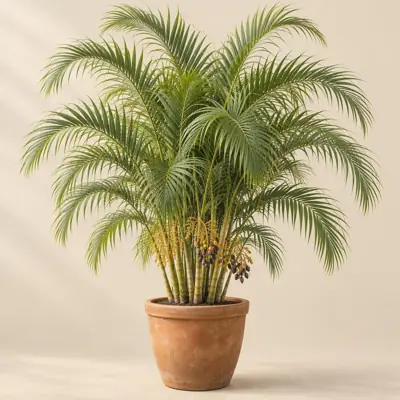
Dypsis lutescens is a perennial evergreen, clustering, multi-stemmed palm that can range in habit from shrub-like to tree-like, with stems growing in clumps from the base.
Overview
Dypsis lutescens is a perennial evergreen, clustering, multi-stemmed palm that can range in habit from shrub-like to tree-like, with stems growing in clumps from the base.
Origin and habitat
Dypsis lutescens is native to Madagascar, mainly eastern Madagascar, and multiple sources describe it as endemic to Madagascar, although sources differ. Its native habitat includes humid coastal areas of eastern Madagascar, including dunes, swamps, gaps in moist forest, sandy riverbanks, and alluvial ground. It is native to humid tropical to subtropical environments and is cold-sensitive; it can be grown outdoors in tropical regions but is generally grown indoors in temperate or cold regions.
Characteristics
Sources differ on mature size, reporting a height of about 400–1200 cm and a spread of about 250–650 cm. It is reported to grow relatively quickly and has pinnate leaves that arch or curve upward, with lance-shaped to linear leaflets and petioles, rachises, or midribs often colored yellow-green to bright yellow. The small flowers occur on branched inflorescences and are generally described as yellow, with sepals and petals; sources differ in their descriptions, and flowering is reported to occur in summer. Sources differ in describing the fruit as ovoid, ellipsoid, or obovoid; it is yellow to orange-yellow at first and becomes purple, purplish-black, or black when mature or dried.
Light
Dypsis lutescens grows in bright filtered light to partial sun and can grow in full sun or moderate shade, while bright indirect light is more suitable indoors and strong direct sunlight may scorch the leaves.
Watering
During active growth, keep the growing medium moist but not waterlogged and ensure good drainage; reduce watering in winter, while established plants have some drought tolerance.
Humidity and airflow
Dypsis lutescens is generally reported to prefer high humidity and need moderate airflow.
Temperature and dormancy
Sources differ, with limited evidence indicating a minimum temperature of about 10 °C. Hardiness guidance places it in warm USDA zones, with one source distinguishing between conditions considered safer for outdoor growth and conditions where plants may recover after frost damage.
Growing medium and mounting
Use a moist but well-drained growing medium; Dypsis lutescens prefers slightly acidic sandy soil, while RHS guidance recommends acidic to neutral loam and a loam-based potting medium.
Feeding
A balanced liquid fertilizer is reported to be suitable during the growing season.
Propagation
Dypsis lutescens can be propagated from seed; fresh seed is better sown promptly, germination takes time, and RHS recommends warm sowing conditions. Other sources also record propagation from suckers.
Common problems
Possible pests include scale insects, mealybugs, thrips, glasshouse thrips, root mealybugs, whiteflies, and red spider mites, while disease problems are generally reported to be uncommon. Indoors, insufficient humidity or poor water management may result in poor growth, and strong direct sunlight may scorch the leaves. Dypsis lutescens is sensitive to low temperatures and frost; some sources indicate that mature plants can briefly tolerate conditions near freezing or light frost, although above-ground growth may be damaged.
Identification
Dypsis lutescens is reported to form multiple slender, bamboo-like stems with ringed leaf scars from the base; the stems and leaf axes are often yellow-green to yellow, and the arching pinnate leaves contribute to its distinctive clustered appearance.
Photos


Sources
- Wikipedia (en): Chrysalidocarpus lutescens — CC BY-SA 4.0 · link
- 維基百科:散尾葵 — CC BY-SA 4.0 · link
- Wikipedia (ja): アレカヤシ — CC BY-SA 4.0 · link
- Wikipedia (de): Goldfruchtpalme — CC BY-SA 4.0 · link
- Wikipedia (fr): Dypsis lutescens — CC BY-SA 4.0 · link
- Wikipedia (es): Dypsis lutescens — CC BY-SA 4.0 · link
- GBIF descriptions: Arbolado urbano de Bogotá D.C asociado a servicios ambientales y culturales valorados como base de l — per dataset · link
- NC State Plant Toolbox: Dypsis lutescens — copyright (facts only) · link
- TaiCOL 臺灣物種名錄: Dypsis lutescens — CC BY 4.0 · link
- Useful Tropical/Temperate Plants: Dypsis lutescens — CC BY-NC-SA 3.0 (facts only) · link
- RHS Plants: Dypsis lutescens — © RHS, facts only · link
- USDA PLANTS Database: Dypsis lutescens — Public domain (US Government work) · link
- NHK みんなの趣味の園芸 植物図鑑: Dypsis (genus-level) — © NHK出版, facts only · link