
Lipstick (Echeveria agavoides)
Echeveria agavoides is a perennial evergreen, rosette-forming succulent with a very short to nearly absent stem; it is usually solitary, although older plants may produce offsets or form clumps.
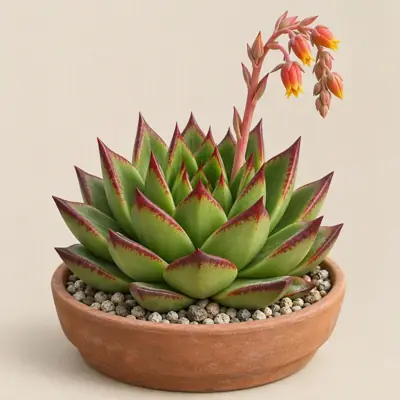
Overview
Echeveria agavoides is a perennial evergreen, rosette-forming succulent with a very short to nearly absent stem; it is usually solitary, although older plants may produce offsets or form clumps.
Origin and habitat
Echeveria agavoides is native to Mexico, with core records concentrated in central Mexico, including San Luis Potosí, Hidalgo, Guanajuato, and Durango; sources differ, with others also listing Aguascalientes, Jalisco, Querétaro, Zacatecas, Coahuila, Oaxaca, and Michoacán. It occurs in rocky canyons, dry slopes, and rocky outcrops at higher elevations, in generally warm, dry subtropical to semi-arid environments.
Characteristics
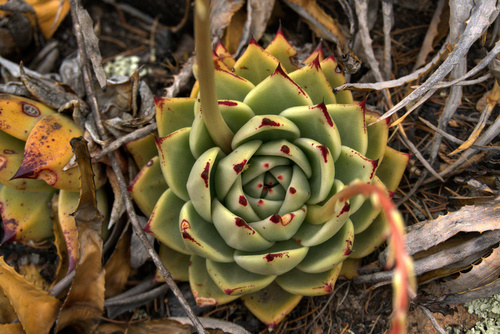
Sources differ and are few, but mature plants are reported at about 8–12 cm tall and about 7–15 cm across. Sources differ on growth: it is described as relatively fast-growing, while offsets may develop slowly or not form. The thick, ovate to triangular leaves have pointed tips and range from green to pale apple green; 'Lipstick' has bright green leaves with irregular red margins, and stronger light generally makes red or bronze coloration at the tips or margins more pronounced. It stores water in its leaves, and its flowers range from pinkish red to orange-red with deep yellow at the petal tips or edges; sources differ on flowering time, with records extending from late spring through summer and most reports describing summer flowering.
Light
Echeveria agavoides prefers abundant light to full sun, and sufficient light helps maintain compact growth, leaf coloration, and flowering. When moved from weaker light into intense summer sun, it should be acclimated gradually to reduce the risk of sunburn.
Watering
Water moderately during active growth while avoiding standing water; Echeveria agavoides tolerates drought but is sensitive to persistently wet roots. In winter, it should be kept nearly dry.
Humidity and airflow
It is generally reported to prefer low humidity.
Temperature and dormancy
Sources are few and give a reported minimum of about 5 °C, while sources differ on its hardiness-zone classification. It is reported to tolerate brief light frost and rests in winter. High temperatures can cause stress; intense sun should be avoided during hot summers, and hot, humid conditions are less favorable.
Growing medium and mounting
Echeveria agavoides needs a fast-draining succulent mix and is prone to rot; mineral-rich or sandy mixes or standard cactus potting mix may be used while avoiding prolonged waterlogging.
Feeding
Small amounts of fertilizer may be applied during active growth; sources describe balanced liquid fertilizer or small amounts of slow-release or liquid fertilizer, and excessive autumn feeding may affect leaf coloration.
Propagation
Propagation methods include leaf cuttings, offsets or division, seed, stem or beheaded cuttings, and rerooting rosettes. When taking stem or leaf cuttings, the cut surface may be allowed to form a callus before planting.
Common problems
Potential pests include mealybugs, scale insects, aphids, spider mites, thrips, root mealybugs, and vine weevils. It generally has no notable disease problems, but overly wet growing medium can increase the risk of root rot and fungal problems, while overwatering or standing water readily causes rot. Insufficient light can cause elongated growth, paler leaves, and loose rosettes. It does not tolerate cold, wet winters or hot, humid conditions; intense summer conditions may call for afternoon shade, and sudden exposure should be avoided when transitioning to full sun.
Identification
Echeveria agavoides is distinguished by a compact rosette of thick, pointed, agave-like triangular leaves; 'Lipstick' is especially recognizable by its green leaves with bright red or irregular red margins.
Photos


Sources
- Wikipedia (en): Echeveria agavoides — CC BY-SA 4.0 · link
- Wikipedia (de): Echeveria agavoides — CC BY-SA 4.0 · link
- Wikipedia (fr): Echeveria agavoides — CC BY-SA 4.0 · link
- Wikipedia (it): Echeveria agavoides — CC BY-SA 4.0 · link
- LLIFLE Encyclopedia of living forms: Echeveria agavoides — CC BY-SA · link
- RHS Plants: Echeveria agavoides — © RHS, facts only · link
- Desert-Tropicals: Echeveria agavoides — © Philippe Faucon (desert-tropicals.com), facts only · link
- The Succulent Plant Page: Echeveria (genus-level) — © R.J. Hodgkiss, facts only · link
- NHK みんなの趣味の園芸 植物図鑑: Echeveria (genus-level) — © NHK出版, facts only · link
- NC State Plant Toolbox: Echeveria (genus-level) — copyright (facts only) · link
- PUKUBOOK: Echeveria agavoides — CC BY-NC (facts only) · link
- Echeveria Agavoides: Grow and Care Guide (houseplantcentral.com) — facts only (§12) · link
- Opuntia ellisiana Spineless Prickly Pear | Planet Desert (planetdesert.com) — facts only (§12) · link
- How to Plant, Grow, and Care for Echeveria Agavoides (www.epicgardening.com) — facts only (§12) · link