
Pulido's Echeveria (Echeveria pulidonis)
Echeveria pulidonis is a low-growing, evergreen, rosette-forming succulent that develops offsets and forms clumps of rosettes as it matures. It is reported to be an evergreen perennial succulent.
Overview
Echeveria pulidonis is a low-growing, evergreen, rosette-forming succulent that develops offsets and forms clumps of rosettes as it matures. It is reported to be an evergreen perennial succulent.
Origin and habitat
Sources differ on its native range in central Mexico: Puebla is explicitly identified, while another account also includes Veracruz. Specific descriptions of its wild habitat are reported to be limited; cultivation guidance draws on Echeveria growing on higher-elevation rocky outcrops in fast-draining conditions as a basis for growing-medium requirements. It is generally reported to suit warm, well-drained Mediterranean-type or subtropical growing conditions.
Characteristics
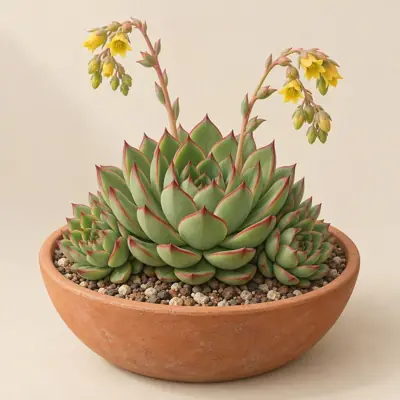
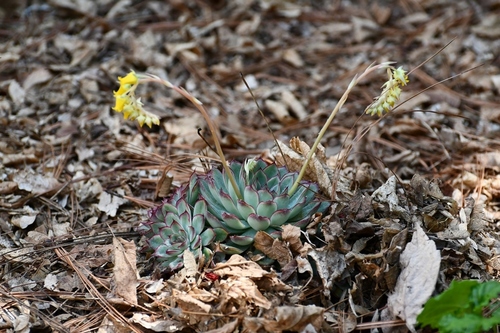
A single source reports a mature height of about 10–50 cm, so sources are few. Sources differ on mature spread, with a reported range of about 10–50 cm. It grows slowly, grows mainly in spring and autumn, and forms clumps over time; its fleshy leaves form rosettes, vary from spoon-shaped to oblong or ovate with pointed tips, and range from pale green or blue-green to a silvery-bloomed appearance, with red margins and tips that may become purplish red during drought or winter. It stores water in its leaves and produces yellow to lemon-yellow, bell-shaped flowers on curved red flower stalks from spring into summer.
Light
Echeveria pulidonis takes full sun and can be grown in full sun to bright, strong light; ample light can reduce stretched growth and intensify the red leaf margins.
Watering
During active growth, water thoroughly after the growing medium dries, reduce watering in winter, avoid prolonged waterlogging, and avoid leaving water sitting on the leaves.
Humidity and airflow
It is reported to prefer low humidity.
Temperature and dormancy
Sources differ on the reported minimum temperature, which is about 5 °C. Its cold minimum is 5 °C, and it is generally reported to tolerate brief light frost. Dormancy is reported to vary. It is reported to be weaker in hot, humid conditions and to benefit from a well-ventilated, partly shaded setting in summer.
Growing medium and mounting
It needs a fast-draining mix; a porous, fast-draining growing medium such as standard cactus mix is suitable, as are loamy or sandy media with acidic, neutral, or alkaline pH.
Feeding
A single source reports using diluted, low-nitrogen fertilizer from late spring through summer.
Propagation
It can be propagated in spring or early summer from stem or leaf cuttings, or by separating offsets in spring; genus-level Echeveria information also records division and seed propagation. Recorded propagation methods include leaf cuttings, stem cuttings, division, and seed.
Common problems
Potential pests include mealybugs, weevils, and aphids. A single source reports that disease problems are generally uncommon. Insufficient light can cause stretched growth, poor drainage or waterlogging can impair growth, and prolonged water remaining on the leaves is also undesirable. It is somewhat cold-hardy but sensitive to frost and prefers warm conditions; when extremely dry it may briefly withstand colder conditions, but this should not be regarded as its routine cold tolerance.
Identification
Echeveria pulidonis is distinguished by compact, strongly geometric rosettes of fleshy blue-green to silvery-green leaves with conspicuous red margins and red tips, together with yellow, bell-shaped flowers.
Photos


Sources
- Wikipedia (en): Echeveria pulidonis — CC BY-SA 4.0 · link
- Wikipedia (fr): Echeveria pulidonis — CC BY-SA 4.0 · link
- LLIFLE Encyclopedia of living forms: Echeveria pulidonis — CC BY-SA · link
- RHS Plants: Echeveria pulidonis — © RHS, facts only · link
- Desert-Tropicals: Echeveria pulidonis — © Philippe Faucon (desert-tropicals.com), facts only · link
- The Succulent Plant Page: Echeveria (genus-level) — © R.J. Hodgkiss, facts only · link
- NHK みんなの趣味の園芸 植物図鑑: Echeveria (genus-level) — © NHK出版, facts only · link
- NC State Plant Toolbox: Echeveria (genus-level) — copyright (facts only) · link
- Echeveria pulidonis | Giromagi cactus and succulents for sale | Buy plants onlin (www.giromagi.com) — facts only (§12) · link
- PUKUBOOK: Echeveria pulidonis — CC BY-NC (facts only) · link