
Firecracker Plant (Echeveria setosa)
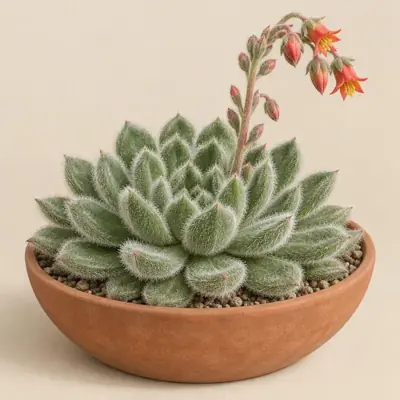
Echeveria setosa is an evergreen perennial, nearly stemless rosette-forming succulent that produces basal offsets and gradually forms dense clumps or mats.
Overview
Echeveria setosa is an evergreen perennial, nearly stemless rosette-forming succulent that produces basal offsets and gradually forms dense clumps or mats.
Origin and habitat
It is native to Mexico, with records particularly from Puebla and Oaxaca and especially clear records from mountainous Puebla or the central Mexican plateau, although sources differ in their accounts. It is reported from Mexican semi-desert environments and the central plateau or mountains of Puebla. It is suited to sunny, well-drained, relatively dry conditions and does not tolerate frost or cold, wet conditions.
Characteristics
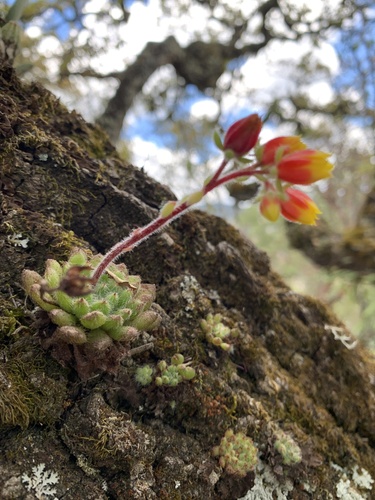
Sources differ on mature size, placing height at about 5–10 cm and spread at about 10–30 cm. Growth is relatively slow, with basal offsets gradually forming clumps; the fleshy green to powdery-green leaves form dense rosettes, are mainly spoon-shaped but are sometimes described as obovate, and usually bear white bristles on their surfaces and margins, though hairiness varies greatly and some plants may be nearly hairless; the leaves may become green-red in winter. The mainly red-and-yellow flowers have bell-shaped to ovoid-urn-shaped corollas on upright to arching, simple or branched inflorescences; flowering occurs from spring into early summer, though sources differ on some flower details. It stores water in its leaves and is reported to produce small reddish-brown follicles containing many seeds.
Light
It takes full sun and can also grow in bright light; ample light in cultivation helps maintain a compact rosette, while afternoon shade may be considered during summer in extremely hot regions, although sources differ in their light recommendations.
Watering
During growth, water thoroughly after the growing medium has dried and avoid waterlogging; in winter, greatly reduce watering and keep conditions relatively dry. Prolonged moisture on the leaves or near the roots may increase the risk of rot.
Humidity and airflow
It is reported to prefer low humidity.
Temperature and dormancy
Sources are few and differ on the lower temperature guidance, with about 7 °C reported as a minimum. RHS hardiness classification and Sunset zone cultivation recommendations are reported, but sources differ. It is frost tender; keep above freezing, while dormancy is reported to vary. Tolerance of high summer temperatures may be limited, particularly in hot, humid conditions, and airy, partly shaded conditions are advised under such heat.
Growing medium and mounting
Use a porous, well-drained cactus or succulent growing medium; loamy or sandy media can also be used. It needs a fast-draining mix.
Feeding
It is reported to accept diluted, low-nitrogen fertilizer from late spring through summer.
Propagation
It can be propagated by seed, leaf cuttings, stem cuttings, basal offsets or young plants, and division.
Common problems
It is reported to be susceptible to mealybugs, weevils and aphids. Significant disease problems are generally not reported, but wet conditions increase the risk of rot or fungal problems, and prolonged moisture on leaves or near the roots may lead to rot. Insufficient light can cause stretched growth, and contact with the white leaf hairs may irritate skin. It is sensitive to frost and low temperatures and is unsuited to prolonged cold, wet conditions; in extremely hot regions, afternoon shade may be needed during summer.
Identification
Distinguishing features include nearly stemless fleshy rosettes, leaves often covered with conspicuous shiny white bristles, and red-and-yellow flowers; the amount of hairiness varies greatly.
Photos


Sources
- Wikipedia (en): Echeveria setosa — CC BY-SA 4.0 · link
- Wikipedia (de): Echeveria setosa — CC BY-SA 4.0 · link
- Wikipedia (fr): Echeveria setosa — CC BY-SA 4.0 · link
- Wikipedia (es): Echeveria setosa — CC BY-SA 4.0 · link
- Wikipedia (it): Echeveria setosa — CC BY-SA 4.0 · link
- LLIFLE Encyclopedia of living forms: Echeveria setosa — CC BY-SA · link
- RHS Plants: Echeveria setosa — © RHS, facts only · link
- Desert-Tropicals: Echeveria setosa — © Philippe Faucon (desert-tropicals.com), facts only · link
- The Succulent Plant Page: Echeveria (genus-level) — © R.J. Hodgkiss, facts only · link
- NHK みんなの趣味の園芸 植物図鑑: Echeveria setosa — © NHK出版, facts only · link
- Echeveria setosa | Mountain Crest Gardens™ (mountaincrestgardens.com) — facts only (§12) · link