
peanut cactus (Echinopsis chamaecereus)
Echinopsis chamaecereus is a low-growing, clustering to creeping cactus that forms dense mats, with stems that can trail outward. It is reported to be perennial.
Overview
Echinopsis chamaecereus is a low-growing, clustering to creeping cactus that forms dense mats, with stems that can trail outward. It is reported to be perennial.
Origin and habitat
Sources differ on its native range: several point to northwestern Argentina around Tucumán and Salta, while the continued existence of wild populations is uncertain. Accounts of its wild habitat also differ, describing high-elevation dry areas, desert, or dry scrub in northwestern Argentina, while other sources say the actual vegetation type is unknown because wild plants were not subsequently found. It is reported from a dry, well-drained environment with marked temperature differences between winter and summer.
Characteristics
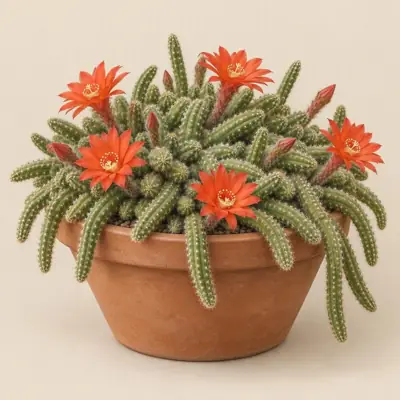
Sources differ, but mature height is reported at about 10–15 cm, while mature spread is 30–50 cm. It produces many lateral offsets and branches outward to form dense mats. Sources describe funnel-shaped flowers commonly ranging from orange and orange-red to bright red, with pink also reported; flowering is mainly from late spring to early summer, though some sources describe a broader spring-to-summer period. The fruit is reported to be dark red and spherical, containing small black seeds.
Light
Echinopsis chamaecereus takes full sun and is also grown in bright light; cultivation sources generally recommend ample sunlight and a bright position indoors.
Watering
Water moderately during the growing season and allow the growing medium to dry between waterings; during winter dormancy, greatly reduce watering, with some sources recommending keeping it completely dry.
Humidity and airflow
It is generally reported to prefer low humidity.
Temperature and dormancy
Sources differ on cold limits, with a reported minimum of about -7 °C; another single-source account also gives about -7 °C. Sources differ on its hardiness-zone classification, while specialist sources describe it as frost hardy. It rests cool and dry in winter.
Growing medium and mounting
It needs a fast-draining cactus or succulent mix; loam can be amended with gravel, coarse sand, or perlite to improve drainage.
Feeding
A small amount of fertilizer can be given during the growing season; sources describe using cactus fertilizer or diluted houseplant fertilizer in spring, or balanced liquid fertilizer during the growing season.
Propagation
It can be propagated from offsets or stem segments, or from seed; offsets detach readily and root easily.
Common problems
Mealybugs, scale insects, and mites may cause problems. Excess moisture, overwatering, or poor drainage can lead to rot or root rot. Stem segments detach easily, which can make handling and repotting difficult. Cold tolerance depends strongly on whether conditions are dry or wet; sources describe greater tolerance when dry, while commercial cultivation sources give more conservative guidance and recommend avoiding lower temperatures or hard frost.
Identification
It has many elongated, finger-like or peanut-like stems with several ribs, densely covered in short, fine, soft white spines; it readily forms clusters and gradually becomes creeping.
Photos


Sources
- GBIF Backbone: Echinopsis chamaecereus H.Friedrich & Glaetzle — CC BY 4.0 · link
- Wikipedia (en): Echinopsis chamaecereus — CC BY-SA 4.0 · link
- Wikipedia (fr): Echinopsis chamaecereus — CC BY-SA 4.0 · link
- Wikipedia (es): Echinopsis chamaecereus — CC BY-SA 4.0 · link
- LLIFLE Encyclopedia of living forms: Echinopsis chamaecereus — CC BY-SA · link
- RHS Plants: Echinopsis chamaecereus — © RHS, facts only · link
- Echinopsis chamaecereus | Succulents and Sunshine (www.succulentsandsunshine.com) — facts only (§12) · link
- Go Nuts for the Peanut Cactus (houseplantcentral.com) — facts only (§12) · link
- Echinopsis chamaecereus or peanut cactus: care, characteristics, and complete cu (www.jardineriaon.com) — facts only (§12) · link
- Echinopsis chamaecereus - Peanut Cactus - Mountain Crest Gardens (mountaincrestgardens.com) — facts only (§12) · link