
Echinopsis subdenudata (Echinopsis subdenudata)
Echinopsis subdenudata is a globular to slightly flattened globular cactus that is usually solitary but can produce basal offsets and gradually form clumps. It is reported to be perennial.
Overview
Echinopsis subdenudata is a globular to slightly flattened globular cactus that is usually solitary but can produce basal offsets and gradually form clumps. It is reported to be perennial.
Origin and habitat
Sources differ on its native range: Bolivia is recorded, northwestern Argentina is also reported, and Paraguay is listed only as a possible part of its distribution. It occurs in varied habitats including grassland, scrub, forest, mountainous areas, and slopes. During the growing season it favors abundant light and can adapt to dry conditions, while regular summer watering is possible and winter conditions should be drier.
Characteristics
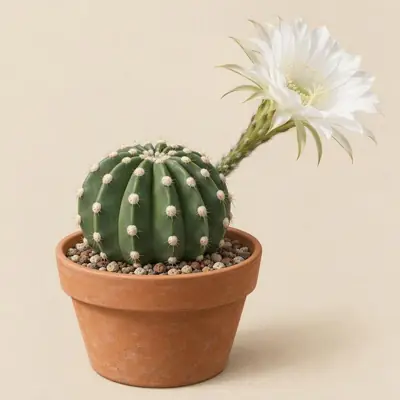
Sources differ, placing mature height at about 5–8 cm and mature spread at about 7–20 cm. It is reported to grow relatively slowly. Sources differ in descriptions of its large, funnel- to trumpet-shaped flowers, which have long floral tubes, are mainly white or pale pink, may be fragrant, generally open at night, and remain fully open only briefly. Flowering occurs from late spring through summer, and the plant is reported to lack ordinary leaves, with its evergreen fleshy stem forming the main visible structure.
Light
It takes full sun and can also grow in bright conditions; sources additionally describe summer partial sun and bright filtered light.
Watering
During the growing season, water regularly while allowing the growing medium to dry between waterings and avoiding standing water; during winter dormancy, greatly reduce watering or keep it relatively dry. The stated winter watering interval is 30–60 days.
Temperature and dormancy
Sources differ on the lower temperature limit, with a figure of about 2 °C reported, while a separate specialist source reports about -7 °C and evidence is limited. It is described as frost hardy, but it is also described as not frost tolerant. It rests cool and dry in winter.
Growing medium and mounting
It needs a very fast-draining, loose, porous growing medium; loam or sandy substrates can be combined with abundant gritty material, perlite, or pumice, and prolonged standing water around the roots should be avoided.
Feeding
It can be fertilized during summer growth, with a high-potassium fertilizer specifically recommended by one cited source.
Propagation
It can be propagated by sowing seed or by separating basal offsets.
Common problems
Mealybugs are reported as a possible pest. It is generally described as having no notable disease problems, while prolonged wet or waterlogged growing medium is associated with rapid root or stem rot. Poor drainage or standing water may cause root and stem rot, while insufficient light does not meet its high-light requirements. Winter frost and cold, wet conditions should be avoided; some sources report tolerance of brief cold when completely dry, but reports of its lower cold limit differ.
Identification
Echinopsis subdenudata has a gray-green to light-green globular stem with a slightly depressed or flattened top and prominent ribs; its spines are extremely short and often hidden in white to creamy-white woolly areoles, so some plants appear nearly spineless, and it can produce long-tubed, night-opening flowers that are very large relative to the plant.
Photos


Sources
- GBIF Backbone: Echinopsis subdenudata Cárdenas — CC BY 4.0 · link
- Wikipedia (en): Echinopsis ancistrophora — CC BY-SA 4.0 · link
- LLIFLE Encyclopedia of living forms: Echinopsis subdenudata — CC BY-SA · link
- RHS Plants: Echinopsis subdenudata — © RHS, facts only · link
- The Succulent Plant Page: Lobivia (genus-level) — © R.J. Hodgkiss, facts only · link
- Echinopsis subdenudata | Easter lily cactus care & info - Houseplant Central (houseplantcentral.com) — facts only (§12) · link
- Echinopsis subdenudata (www.promessedefleurs.ie) — facts only (§12) · link
- Echinopsis subdenudata | Giromagi cactus and succulents for sale | Buy plants on (www.giromagi.com) — facts only (§12) · link