
Scorpionbush (Ehretia microphylla)
Ehretia microphylla is reported to grow as a shrub to small tree, with slender, much-branched stems.
Track your Scorpionbush in the PLNTverse app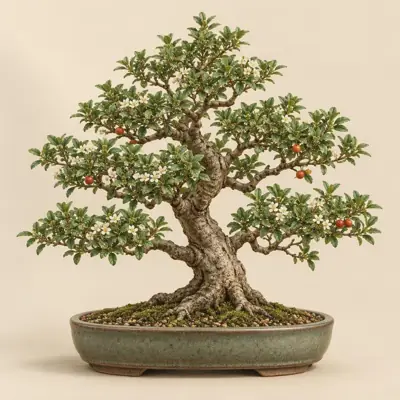
Overview
Ehretia microphylla is reported to grow as a shrub to small tree, with slender, much-branched stems.
Origin and habitat
Ehretia microphylla is native across southern, eastern, and southeastern Asia, including India, Sri Lanka, Indochina, southern China, Taiwan, the Ryukyu Islands of Japan, and the Malay Archipelago, extending to New Guinea, the Cape York Peninsula of northern Australia, and the Solomon Islands; TaiCOL lists it as native to Taiwan but not endemic there. It is reported from lowland and near-coastal environments, including semi-evergreen vine thickets on the Cape York Peninsula, drier terraces on Christmas Island, and rainforest. Its distribution spans tropical to subtropical parts of Asia, Pacific islands, and northern Australia.
Characteristics
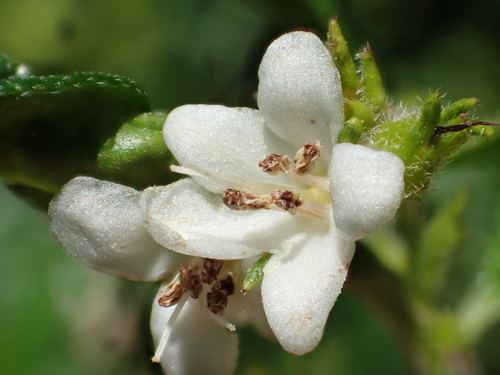
Sources differ on mature height, placing it at about 100–300 cm. The leaves are reported to be small and simple, often nearly sessile or short-petioled, usually obovate to oblanceolate or spoon-shaped, sometimes leathery, and potentially rough to the touch because of stiff hairs. The small flowers are reported to have white corollas, sometimes with a reddish tinge, with lobed corollas borne in axillary inflorescences. Sources differ on flowering season, with Japanese information describing a particular seasonal period while another source reports that flowers may be seen throughout the year; the nearly spherical drupes are reported in mature colors including red, yellow, orange, and brownish orange.
Propagation
Ehretia microphylla is reported to be propagated from seed or from semi-ripe stem cuttings taken in spring or summer.
Common problems
Reported pests include spider mites, aphids, scale insects, and slugs. Root rot may occur, and downy mildew has also been recorded; unsuitable growing media are reported to increase the risk of root rot. Insufficient water is reported to cause leaf drop, while excessive watering may cause leaf yellowing.
Identification
Ehretia microphylla is reported to be low-growing and much branched, with small leaves that are often rough-surfaced, small white flowers, and spherical drupes. Its small leaves and abundant flowers are reported as features that lead to its frequent use for bonsai.
Photos



Sources
- Wikipedia (en): Ehretia microphylla — CC BY-SA 4.0 · link
- 維基百科:基及树 — CC BY-SA 4.0 · link
- Wikipedia (ja): フクマンギ — CC BY-SA 4.0 · link
- Wikipedia (de): Fukientee — CC BY-SA 4.0 · link
- Wikipedia (fr): Carmona retusa — CC BY-SA 4.0 · link
- Wikipedia (es): Ehretia microphylla — CC BY-SA 4.0 · link
- TaiCOL 臺灣物種名錄: Ehretia microphylla — CC BY 4.0 · link