
Devil's Ivy (Epipremnum aureum)
Epipremnum aureum is a perennial evergreen climbing or trailing vine that uses aerial roots to attach to supports and can also be grown indoors for its foliage or in hanging containers.
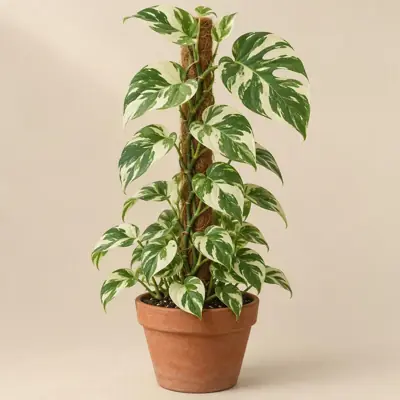
Overview
Epipremnum aureum is a perennial evergreen climbing or trailing vine that uses aerial roots to attach to supports and can also be grown indoors for its foliage or in hanging containers.
Origin and habitat
Sources differ on origin accounts: the accepted native range for the species is Mo'orea in the Society Islands of French Polynesia, while the 'N'Joy' selection is recorded as a variant plant discovered in India. The species is native to tropical rainforest habitat, where it can climb trees and is adapted to filtered understory light or partial sun. It is reported to favor a warm, humid tropical to subtropical climate.
Characteristics
Sources differ, but with few sources its mature height is reported at about 400–800 cm, while its mature spread is reported at about 100–150 cm. Leaves are alternate; juvenile leaves are usually smaller, ovate to heart-shaped, and entire, while mature climbing plants can develop large leaves that are deeply divided to irregularly pinnately divided, with yellow or creamy-yellow markings on the species. The inflorescence consists of the typical aroid spadix and spathe, flowering is extremely rare under cultivation, and application of gibberellin can induce flowering.
Light
Epipremnum aureum does well in partial sun or bright filtered light, and artificial lighting can supplement insufficient indoor light. It tolerates low light, although very weak light may reduce variegation, while prolonged strong direct light may scorch the leaves.
Watering
Water after the growing medium dries; from spring through autumn, watering can be done as the surface begins to dry, while conditions should be kept drier in winter. Avoid prolonged overwatering to reduce root problems.
Humidity and airflow
It is generally reported to prefer high humidity.
Temperature and dormancy
With few sources and differing accounts, the minimum temperature is reported at about 5 °C, while a source reports an ideal range of about 17–30 °C. It is generally reported to tolerate brief light frost. A source reports a warm hardiness range.
Growing medium and mounting
Use a fertile, well-drained growing medium; the species can adapt to various soil textures, with container culture focused on avoiding waterlogging. It has aerial and soil roots and is suited to an airy mix.
Feeding
Sources differ on feeding: one account recommends regular feeding outside winter dormancy, while another recommends liquid fertilizer in spring.
Propagation
Propagate by stem cuttings using stem sections with nodes; reports describe rooting, sprouting, and later development of a fuller root system.
Common problems
Potential pests include scale insects, spider mites, and greenhouse thrips. Anthracnose is reported to occur and may require greater attention under hot, humid conditions. Overwatering may be associated with root rot, yellowing, and wilting, while excessive dryness or low temperatures may also cause yellowing and wilting; strong direct sunlight can scorch leaves, and insufficient light may reduce variegation. The plant is sensitive to cold, and leaves can be damaged by a sudden move from weak light to strong sunlight or by prolonged strong direct light; outdoor-grown plants should be moved indoors during cold weather.
Identification
Epipremnum aureum climbs using aerial roots, and its leaves become markedly larger as the plant matures and climbs upward, with mature leaves developing deep divisions; indoor container plants usually retain juvenile leaf form.
Photos


Sources
- Wikipedia (en): Epipremnum aureum — CC BY-SA 4.0 · link
- 維基百科:绿萝 — CC BY-SA 4.0 · link
- Wikipedia (ja): ポトス — CC BY-SA 4.0 · link
- Wikipedia (de): Efeutute — CC BY-SA 4.0 · link
- Wikipedia (fr): Epipremnum aureum — CC BY-SA 4.0 · link
- Wikipedia (es): Epipremnum aureum — CC BY-SA 4.0 · link
- NC State Plant Toolbox: Epipremnum aureum — copyright (facts only) · link
- Wikipedia (it): Epipremnum aureum — CC BY-SA 4.0 · link
- Wikipedia (nl): Epipremnum aureum — CC BY-SA 4.0 · link
- Wikipedia (pt): Epipremnum aureum — CC BY-SA 4.0 · link
- Wikipedia (ko): 스킨답서스 — CC BY-SA 4.0 · link
- RHS Plants: Epipremnum aureum — © RHS, facts only · link
- USDA PLANTS Database: Epipremnum aureum — Public domain (US Government work) · link
- 臺北典藏植物園 植物資料庫: Epipremnum aureum — © 臺北典藏植物園, facts only · link