
Flame violet (Episcia cupreata)
Episcia cupreata is a low-growing, creeping or trailing herbaceous plant with runners that can form clumps, and it is commonly grown indoors in pots or hanging containers. It is an evergreen perennial herb.
Overview
Episcia cupreata is a low-growing, creeping or trailing herbaceous plant with runners that can form clumps, and it is commonly grown indoors in pots or hanging containers. It is an evergreen perennial herb.
Origin and habitat
Sources differ on its native range, describing tropical areas from Central America into South America, with accounts including Panama, Colombia, Venezuela, Ecuador and Brazil, while broader plant catalogues describe a range from El Salvador to Ecuador, Venezuela and northwestern Brazil. It grows in forest environments, including stream valleys and river-gorge forests, and favors partially shaded, warm and humid conditions. Its climate is tropical, warm and relatively humid, with records spanning from lowland to higher-elevation settings in Colombia.
Characteristics
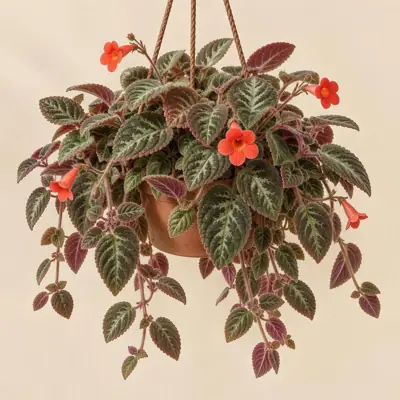
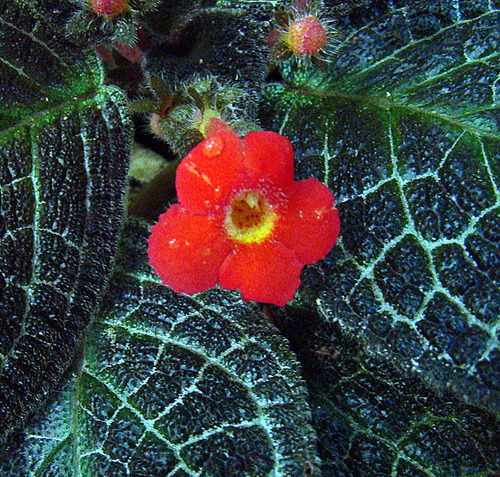
Based on a single source, mature plants are reported to reach about 0–10 cm in height and about 50–100 cm in spread; sources are few for these measurements. The opposite leaves are elliptic to elliptic-ovate, hairy and somewhat thick, with low or bluntly toothed margins; their color is highly variable, including dark green, reddish brown, copper-brown or red and green, often with silvery-green veins or silver to purplish-red markings and sometimes purple or copper coloring beneath. Sources differ in their flower descriptions: flowers arise from the leaf axils, are usually solitary and funnel-shaped to obliquely funnel-shaped, with typical corollas orange-red to bright red and yellow in the tube or throat, while cultivated varieties and hybrids may also have pink, deep pink, white or yellow flowers. Sources differ on flowering time, describing flowering mainly from summer into autumn or intermittent flowering from spring through autumn under suitable conditions.
Light
Provide bright indirect light to partial shade and avoid strong direct sunlight; it tolerates heavier shade and can also be grown indoors under artificial lighting.
Watering
During the growing season, maintain moderate moisture and water thoroughly while using a well-drained medium that is allowed to dry slightly; reduce watering in winter and avoid prolonged excess moisture or directly wetting the leaves.
Humidity and airflow
Episcia cupreata prefers high humidity and needs moderate airflow.
Temperature and dormancy
Sources differ on the reported minimum temperature, with limited evidence suggesting about 15 °C. Hardiness is described using USDA and RHS classifications, and the plant is frost tender and should be kept above freezing.
Growing medium and mounting
Use a well-drained potting medium; RHS specifies loam that remains moist but well drained and may be acidic, neutral or alkaline.
Feeding
During the growing season, one source recommends regular applications of a high-potassium fertilizer, while another horticultural source recommends a slow-release fertilizer applied periodically.
Propagation
Propagation is mainly by runners and their rooted plantlets, and stem cuttings and division can also be used; sources additionally record propagation by seed and leaf cuttings, with cuttings also possible during warm periods of active growth. Vegetative propagation by runners is generally the more common method under natural or ordinary cultivation conditions.
Common problems
Potential pests include aphids, mealybugs, greenhouse leafhoppers, thrips, weevils and tarsonemid mites. Possible diseases include fungal leaf spots, stem blight or wilt, root rot, basal rot and gray mold, with overwatering increasing the risk of rot. Strong direct sunlight can scorch leaves; overwatering or insufficient airflow can cause decline or rot, while low humidity or overly dry conditions can brown leaf margins or cause the plant to contract, and frequently wet leaves may be damaged. The plant is sensitive to strong sun and low temperatures, is frost sensitive, and should be protected from freezing.
Identification
Episcia cupreata is hairy throughout, with short stems and hairy creeping runners; its leaves have conspicuous colors and patterns, often with pale or silver veins and purple undersides, while the funnel-shaped red to orange-red flowers have yellow throats and plantlets can form at runner tips.
Photos


Sources
- Wikipedia (en): Episcia cupreata — CC BY-SA 4.0 · link
- Wikipedia (ja): ハイベニギリ — CC BY-SA 4.0 · link
- GBIF descriptions: Catálogo de Plantas y Líquenes de Colombia; Flora y fauna del municipio de Rionegro, Santander — per dataset · link
- NC State Plant Toolbox: Episcia cupreata — copyright (facts only) · link
- 農業知識入口網 植物圖鑑: Episcia cupreata — © MOA, facts only · link
- RHS Plants: Episcia cupreata — © RHS, facts only · link
- USDA PLANTS Database: Episcia cupreata — Public domain (US Government work) · link
- Top Tropicals catalog: Episcia cupreata — © Top Tropicals LLC (facts only) · link