
Rough Horsetail (Equisetum hyemale)
Sources differ in describing Equisetum hyemale as an upright, columnar, rhizomatous perennial herbaceous fern that often forms dense stands, with stems usually unbranched or only occasionally bearing short lateral branches. It is perennial; several sources describe it as evergreen, while an English-language source reports that above-ground stems usually die back in cold climates.
Overview
Sources differ in describing Equisetum hyemale as an upright, columnar, rhizomatous perennial herbaceous fern that often forms dense stands, with stems usually unbranched or only occasionally bearing short lateral branches. It is perennial; several sources describe it as evergreen, while an English-language source reports that above-ground stems usually die back in cold climates.
Origin and habitat
Sources differ on the taxonomic treatment of North American populations, while the core native range is described as extending from Europe into northern and central Asia and including Iceland, Greenland, and Japan. It favors continuously moist environments, including stream and river banks, riparian areas, lake and pond margins, ditches, marshes, wetlands, springs or seepage areas, and moist forests and forest edges; it can form extensive stands and tolerate occasional flooding. It occurs mainly from the southern subarctic to temperate regions of the Northern Hemisphere and is adapted to cold conditions; above-ground stems may remain green in warmer areas but may die back seasonally in colder areas.
Characteristics
Sources differ on mature height, placing it at about 30–250 cm, while the few available sources report a mature spread of about 50–100 cm. It can spread rapidly through underground rhizomes and form dense stands, and its spread may need to be restricted in cultivation. The leaves are generally reported to be extremely small and reduced, joining at the stem nodes into sheaths held close to the stem; these are often dark to blackish green and have teeth at the top. It does not flower or form fruit or seeds; it reproduces by spores, with spore-bearing cones forming at stem tips, and a German source reports a defined period of spore formation during the year.
Light
It grows in full sun to partial shade, while some sources also record it in shadier stream-bank and forest environments.
Watering
Keep the soil continuously moist to waterlogged and avoid drought; it can be grown as a bog or shallow-water plant, and the RHS also recommends cultivation in shallow water.
Temperature and dormancy
Sources differ and are few regarding minimum temperature, with a reported value of about -30 °C. It is frost hardy, with hardiness classifications reported by multiple sources.
Growing medium and mounting
It suits fertile soil that remains continuously moist to poorly drained and can grow in clay, loam, or sand, under acidic, neutral, or alkaline conditions; natural habitats also include base-rich loam and clay and sandy riverbank soils.
Propagation
It can be propagated by division in spring; naturally it can reproduce by spores and spread through underground rhizomes or rhizome fragments.
Common problems
It is generally reported to have few pest or disease problems. Its underground rhizomes can extend deeply and outward, potentially spreading rapidly and becoming difficult to control in gardens; large containers or pots can be used to restrict its spread. It does not tolerate drought, so the growing medium should not remain dry for prolonged periods; it tolerates occasional flooding and is strongly cold tolerant.
Identification
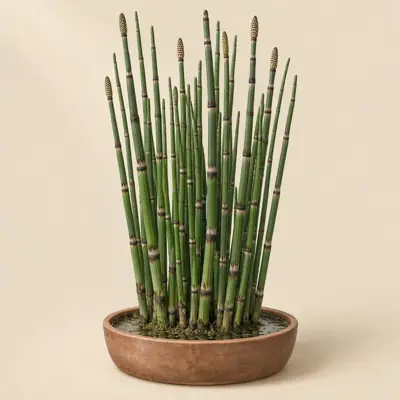
It is generally reported to have upright, green, hollow stems with conspicuous nodes and longitudinal ridges, a hard, rough texture, and silica-rich surfaces; dark leaf sheaths occur at the nodes, the stems are usually unbranched, and short spore-bearing cones may occur at their tips.
Photos


Sources
- Wikipedia (en): Equisetum hyemale — CC BY-SA 4.0 · link
- 維基百科:木贼 — CC BY-SA 4.0 · link
- Wikipedia (ja): トクサ — CC BY-SA 4.0 · link
- Wikipedia (de): Winter-Schachtelhalm — CC BY-SA 4.0 · link
- Wikipedia (fr): Prêle d'hiver — CC BY-SA 4.0 · link
- Wikipedia (es): Equisetum hyemale — CC BY-SA 4.0 · link
- GBIF descriptions: Database of Vascular Plants of Canada (VASCAN); Validated red lists of Flanders, Belgium; Nordic Cro — per dataset · link
- Wikipedia (nl): Schaafstro — CC BY-SA 4.0 · link
- Wikipedia (ko): 속새 — CC BY-SA 4.0 · link
- Useful Tropical/Temperate Plants: Equisetum hyemale — CC BY-NC-SA 3.0 (facts only) · link
- RHS Plants: Equisetum hyemale — © RHS, facts only · link
- USDA PLANTS Database: Equisetum hyemale — Public domain (US Government work) · link
- Top Tropicals catalog: Equisetum hyemale — © Top Tropicals LLC (facts only) · link