
loquat (Eriobotrya japonica)
Eriobotrya japonica is a perennial evergreen shrub to small tree, typically with a rounded crown and relatively short trunk.
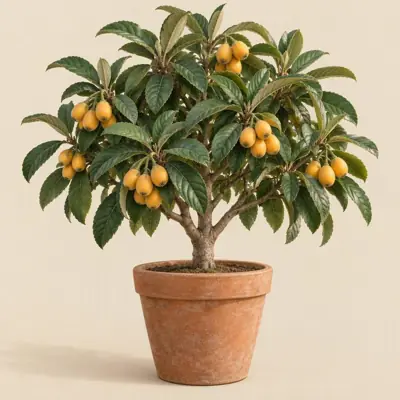
Overview
Eriobotrya japonica is a perennial evergreen shrub to small tree, typically with a rounded crown and relatively short trunk.
Origin and habitat
Sources differ on the native range: it is native to China, with more specific accounts placing it from south-central to southwestern China and explicitly mentioning Chongqing and Hubei. It is described as native to cooler hilly regions of China and is now widely cultivated or introduced in subtropical regions and temperate regions with mild winters. It is suited to subtropical climates and temperate climates with mild winters, and in tropical regions it can be grown at higher elevations.
Characteristics
Sources differ, but mature height is about 500–1000 cm; the few available sources report a spread of about 400–800 cm. Sources differ in describing the growth rate as moderate; the alternate, simple leaves are thick and leathery, dark green, serrated, and hairy underneath. The fragrant flowers are usually white and borne in panicles or clusters; they flower from autumn into winter, reportedly extending into late winter in some regions. The fruits grow in clusters and range from round or oval to pear-shaped, with mature skin usually yellow to orange and sometimes flushed red; the juicy flesh can be white, yellow, or orange, with flavors ranging from sweet to sweet-tart, and ripening varies with climate from late winter or spring into early summer.
Light
Full sun is best, though bright, light shade is also acceptable; greenhouse cultivation can use full sun or bright filtered light.
Watering
It is generally reported to need moderate watering during growth, with the growing medium kept only slightly moist in winter and well drained.
Temperature and dormancy
Sources differ, but the reported minimum temperature is about -12 °C. The few available sources report an ideal temperature of about 21–27 °C and a maximum of about 36 °C.
Growing medium and mounting
Fertile, well-drained soil is preferred, though it adapts to various well-drained soils, including chalk, clay, loam, and sand, across acidic, neutral, and alkaline conditions.
Feeding
During active growth, a balanced liquid fertilizer is generally reported to be suitable for regular application.
Propagation
It is reported to be propagated from seed in spring or by semi-ripe cuttings in summer.
Common problems
Aphids are reported as a possible pest, while reported diseases and disorders include fire blight, rots, cankers, other leaf or branch dieback problems, scab, and leaf spots. Dropped ripe fruit can create litter around fruiting sites, and strong winds can adversely affect the plant. Sources differ on its cold sensitivity: the plant itself is relatively cold tolerant, but flowers, young leaves, and young fruit are notably more susceptible to frost; strong winds should also be avoided.
Identification
Distinguishing features include large, thick, leathery, serrated leaves densely hairy underneath, along with flowering in autumn and winter and fruiting relatively early in the following year, unlike most fruit trees.
Photos


Sources
- GBIF Backbone: Eriobotrya japonica (Thunb.) Lindl. — CC BY 4.0 · link
- Wikipedia (en): Loquat — CC BY-SA 4.0 · link
- 維基百科:枇杷 — CC BY-SA 4.0 · link
- Wikipedia (ja): ビワ — CC BY-SA 4.0 · link
- Wikipedia (de): Japanische Wollmispel — CC BY-SA 4.0 · link
- Wikipedia (fr): Eriobotrya japonica — CC BY-SA 4.0 · link
- Wikipedia (es): Eriobotrya japonica — CC BY-SA 4.0 · link
- GBIF descriptions: Manual of the Alien Plants of Belgium; The checklist of alien seed plants of D.R. Congo, based on ev — per dataset · link
- NC State Plant Toolbox: Eriobotrya japonica — copyright (facts only) · link
- Useful Tropical/Temperate Plants: Eriobotrya japonica — CC BY-NC-SA 3.0 (facts only) · link
- RHS Plants: Eriobotrya japonica — © RHS, facts only · link
- USDA PLANTS Database: Eriobotrya japonica — Public domain (US Government work) · link