
rocketsalad (Eruca vesicaria)
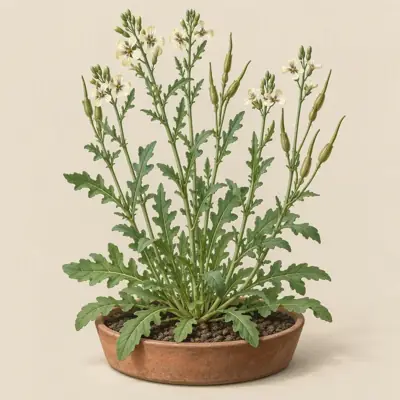
Eruca vesicaria is an erect, branching annual herb that can form a basal rosette before producing one or more flowering stems.
Overview
Eruca vesicaria is an erect, branching annual herb that can form a basal rosette before producing one or more flowering stems.
Origin and habitat
Sources differ on its native range: the Mediterranean region, including Spain, Morocco, and Algeria, is described as its core native area, while some sources extend the native range into southern Europe, North Africa, western Asia, the Arabian Peninsula, and areas farther east. Habitats include rocky ground and wasteland in the Mediterranean region, as well as grassland, tall-herb vegetation, woodland, cultivated land, gardens, parks, and other disturbed environments. It is suited to growth during cooler seasons and, although associated with native Mediterranean environments, can also escape cultivation or become naturalized in temperate regions.
Characteristics
Sources differ on mature height, placing it at about 20–100 cm, while a single source reports a mature spread of about 20.32–45.72 cm. It is reported to be easy to cultivate and quick to mature. The green leaves vary with position and development: basal or lower leaves may be stalked and are typically fiddle-shaped and pinnately lobed to deeply divided, with narrow lateral lobes and a larger terminal lobe, while upper stem leaves are unstalked to short-stalked and simpler; young leaves may begin spoon-shaped before becoming more deeply divided. The bisexual flowers have petals ranging from creamy white or white to pale yellow with dark brown, dark red, or purple veins; flowering is generally reported from spring into early summer, with one source also reporting flowering in late winter, and the fruit is a generally linear to oblong pod with a seedless terminal segment and seeds arranged in two rows.
Light
Eruca vesicaria grows in full sun to partial shade, and moderate shade in hot areas can reduce early bolting caused by high temperatures.
Watering
It prefers moist but well-drained soil, tolerates somewhat wet soil to a degree, and has some drought tolerance once established.
Temperature and dormancy
Eruca vesicaria is generally reported to be frost hardy.
Growing medium and mounting
It adapts to chalk, clay, loam, and sand, prefers well-drained sandy or sandy-loam soil as well as fertile moist soil, and can grow in acidic, neutral, or alkaline conditions.
Propagation
It can be propagated from seed by direct sowing or by raising seedlings indoors before transplanting, and it may also self-sow on disturbed soil.
Common problems
Sources differ on pest problems: they generally describe few pest problems, while NC State reports that common vegetable insects and related pests may occur. Few disease problems are generally reported, although seedlings may develop damping-off and other diseases of vegetable seedlings. It is reported to bolt and flower readily in hot weather, after which leaf growth stops. It prefers cool spring and autumn conditions; heat promotes bolting, while light frost can inhibit growth and may cause the leaves to turn from green to red.
Identification
Sources describe its distinction from Eruca sativa differently, but reported distinguishing characters include whether the sepals persist, the form of the pod or its beak, and plant form; some reproductive isolation is also reported, and the epithet vesicaria is associated with enlarged sepals in fruit.
Photos


Sources
- Wikipedia (en): Eruca vesicaria — CC BY-SA 4.0 · link
- 維基百科:胀萼芝麻菜 — CC BY-SA 4.0 · link
- Wikipedia (de): Senfrauke — CC BY-SA 4.0 · link
- Wikipedia (fr): Eruca vesicaria — CC BY-SA 4.0 · link
- Wikipedia (es): Eruca vesicaria — CC BY-SA 4.0 · link
- GBIF descriptions: The checklist of alien seed plants of D.R. Congo, based on evidence from herbarium collections; Data — per dataset · link
- NC State Plant Toolbox: Eruca vesicaria — copyright (facts only) · link
- Useful Tropical/Temperate Plants: Eruca vesicaria — CC BY-NC-SA 3.0 (facts only) · link
- RHS Plants: Eruca vesicaria — © RHS, facts only · link
- USDA PLANTS Database: Eruca vesicaria — Public domain (US Government work) · link