Crown Pineapple Lily (Eucomis comosa)
Eucomis comosa is a clump-forming, deciduous bulbous perennial with a basal rosette of leaves.
Overview
Eucomis comosa is a clump-forming, deciduous bulbous perennial with a basal rosette of leaves.
Origin and habitat
Eucomis comosa is native from the Eastern Cape to KwaZulu-Natal in South Africa. It is reported to occur in rocky ground at higher elevation.
Characteristics
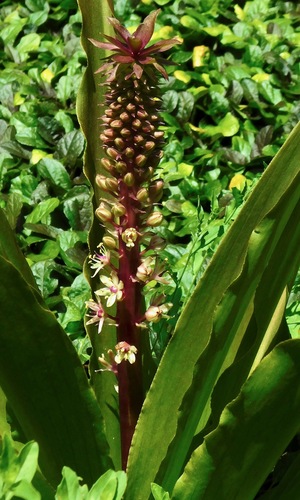
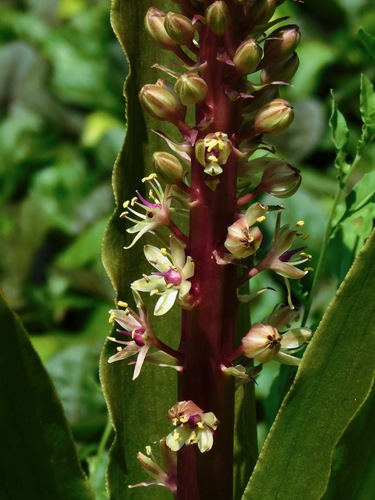
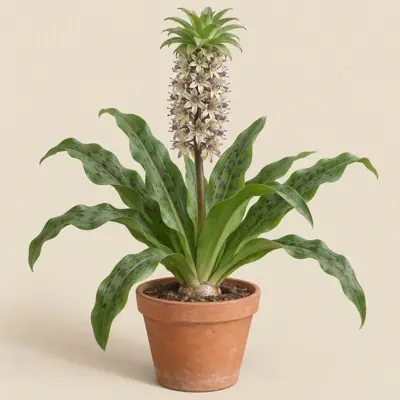
Sources differ on mature size, placing height at about 50–100 cm and spread at about 10–50 cm. Growth is generally reported to be moderate, with green, strap-shaped to lance-shaped leaves forming a basal rosette; the entire, slightly wavy margins and leaves commonly show purple spots or a purple tinge. Small, star-shaped flowers are densely arranged in racemes and may be white, greenish white, pink, or purple depending on the cultivar, with a tuft of green, leaf-like bracts at the top; flowering occurs from summer to late summer and is sometimes described as extending into early autumn. The fruit is reported to be purple to pale purple, fleshy and indehiscent, and ornamental from summer into autumn.
Light
Grow in full sun to partial sun; a sheltered position in full sun is specifically recommended by RHS.
Watering
Keep the soil moist but not waterlogged during growth and flowering, using moderate watering and watering again after the surface soil dries.
Temperature and dormancy
One source reports a lower temperature of about -10 °C; sources are few. Hardiness is described in USDA zones without a specific numerical range stated here. It is generally reported to be frost tender; keep above freezing.
Growing medium and mounting
Use fertile, humus-rich or organic-rich, well-drained soil; it can grow in loamy, sandy, or chalky soils with acidic, neutral, or alkaline pH.
Feeding
Organic compost and slow-release fertilizer are reported to be suitable additions to the soil.
Propagation
It is reported to be propagated by sowing seed in autumn or spring, or by separating offset bulbs in spring.
Common problems
Pests and diseases are generally reported to be uncommon. Avoid excessively wet or waterlogged soil, and provide additional winter protection in cold regions. Sources differ on winter protection in cold and frosty areas, with descriptions including a thick layer of mulch or moving containers or bulbs to a protected place for overwintering.
Identification
The upright, dense flower cluster is topped by a crown of leaf-like bracts, giving it a miniature pineapple-like outline; the leaves and flower stalks also commonly show purple spots, stripes, or flushes.
Photos