
Euphorbia bupleurifolia (Euphorbia bupleurifolia)
Euphorbia bupleurifolia is a low-growing, spineless caudiciform succulent with a short, swollen stem. It is reported to be perennial.
Overview
Euphorbia bupleurifolia is a low-growing, spineless caudiciform succulent with a short, swollen stem. It is reported to be perennial.
Origin and habitat
Sources differ on its native range; it is recorded from South Africa, mainly the Eastern Cape and KwaZulu-Natal. It grows in semi-arid grassland, open scrub and savanna, as well as in shallow soil among rocks, typically with sparse grass cover. It is reported from a tropical, semi-arid environment with a distinct wet-and-dry-season rhythm.
Characteristics
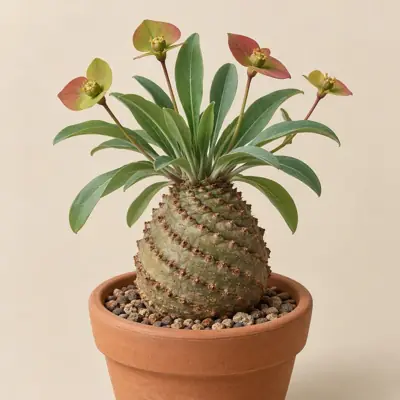
Sources differ on mature height, placing it at about 4–20 cm, and it grows slowly. The leaves form a crown at the stem apex; they are lance-shaped to spoon-shaped lanceolate, green and non-succulent, emerging in the wet season and falling in the dry season. Small, solitary cyathia occur near the top of the plant, with a pair of broadly ovate bracts that change from yellow-green or green to red; flowering is reported to occur in spring. The fruit is nearly stalkless and bluntly lobed, with smooth, ovate seeds; the plant has a swollen stem that is reported to remain relatively short and thick.
Light
Sources differ on light: recommendations range from bright shade or bright partial shade to sun or partial sun, with bright partial shade considered more suitable in summer.
Watering
Water during the growing season, and in hot conditions avoid leaving the medium completely dry for prolonged periods; in winter, greatly reduce watering or keep it dry to reduce the risk of rot. It is generally recommended to keep it evenly moist while in leaf and to withhold water while leafless.
Humidity and airflow
It is reported to prefer high humidity and to need moderate airflow.
Temperature and dormancy
Keep Euphorbia bupleurifolia at or above 10 °C; it is frost tender and should be kept above freezing. It is reported to drop its leaves and go dormant, with dormancy triggered by drought.
Growing medium and mounting
It needs a very fast-draining medium with a relatively high mineral content and little organic matter.
Feeding
It is reported that leafy succulent Euphorbia can receive a high-nitrogen fertilizer at the start of the growing season, with a balanced fertilizer used at other times.
Propagation
Euphorbia bupleurifolia is reported to be usually propagated by seed.
Common problems
Excessively wet medium in winter or during periods of low growth can readily lead to rot. It does not tolerate low temperatures well, while cold tolerance may increase somewhat when it is dormant and dry.
Identification
The brown caudiciform stem ranges from globose or barrel-shaped to columnar and is usually unbranched, with densely arranged dark reddish-brown corky, tuberculate leaf scars from old leaves forming a spiral pattern. A crown of leaves grows at the top, and the overall plant is often described as resembling a pine cone or pineapple.
Photos


Sources
- GBIF Backbone: Euphorbia bupleurifolia Jacq. — CC BY 4.0 · link
- Wikipedia (en): Euphorbia bupleurifolia — CC BY-SA 4.0 · link
- Wikipedia (de): Euphorbia bupleurifolia — CC BY-SA 4.0 · link
- Wikipedia (es): Euphorbia bupleurifolia — CC BY-SA 4.0 · link
- LLIFLE Encyclopedia of living forms: Euphorbia bupleurifolia — CC BY-SA · link
- The Succulent Plant Page: Euphorbia (genus-level) — © R.J. Hodgkiss, facts only · link
- PUKUBOOK: Euphorbia bupleurifolia — CC BY-NC (facts only) · link
- Euphorbia bupleurifolia - Araflora (www.araflora.com) — facts only (§12) · link