
star euphorbia (Euphorbia stellata)
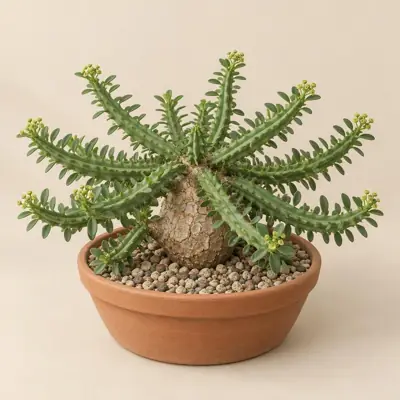
Euphorbia stellata is a small geophytic, terrestrial succulent Euphorbia with an underground caudex and radiating, Medusa-like branches.
Overview
Euphorbia stellata is a small geophytic, terrestrial succulent Euphorbia with an underground caudex and radiating, Medusa-like branches.
Origin and habitat
Euphorbia stellata is native to South Africa's Eastern Cape, with records specifically referring to the Port Elizabeth, Albany, and Peddie areas. It grows among grasses and gravel, often in fully exposed sites, with its thick underground caudex buried in the soil and anchored in rock crevices while branches radiate outward and lie along the ground. It is reported to be adapted to hot, strongly sunlit, relatively dry conditions, with its underground water-storing caudex providing good drought tolerance.
Characteristics
It is reported to grow slowly, with suitable water, warmth, and fertilizer during active growth increasing its growth rate. The inflorescences are reported to be greenish yellow, with small cyathia on short stalks and pale-yellow, elongated nectar glands that nearly meet one another; the fruit is reported to be distinctly divided and truncate at the base. It is reported to have both stem and root swollen, forming a caudex with radiating branches.
Light
It grows in full sun to bright partial sun and can tolerate moderate shade, but plants kept shaded for long periods should be gradually acclimated before exposure to strong sunlight to avoid sunburn; stronger light also produces more pronounced coloration.
Watering
Water regularly during active growth without allowing water to collect around the roots, and keep the plant almost completely dry in winter; although drought tolerant, it can grow better with appropriate watering during active growth. It is generally recommended to withhold water while leafless.
Humidity and airflow
It is reported to need moderate airflow.
Temperature and dormancy
Sources differ on the cold limit, with a reported minimum of about -6 °C; another specialist account also gives about -6 °C, so evidence is limited. It is reported to tolerate brief light frost and to have high heat tolerance. A specialist source reports a USDA hardiness-zone classification for the species.
Growing medium and mounting
Sources describe the medium somewhat differently, but indicate a very loose, aerated, rapidly draining mix dominated by inorganic materials such as clay granules, pumice, and volcanic gravel, with only a small amount of peat or leaf humus, and a container with ample drainage holes. It is also reported to need a very fast-draining mix.
Feeding
Sources differ on feeding, describing either a high-potassium cactus and succulent fertilizer containing trace elements in summer or a slow-release fertilizer.
Propagation
It is reported to propagate by seed or cuttings, with seed-grown plants forming symmetrical caudices more readily, while cuttings generally do not naturally form a caudex and may be cut back again after strong growth to encourage one to form. Cut surfaces on cuttings are reported to be dried before planting to reduce the risk of rot.
Common problems
Rot is reported as a principal problem, with lower risk when watering and airflow are appropriately managed. An overly wet medium or water collecting around the roots may cause rot, while abruptly moving a shaded plant into strong full sun may cause severe sunburn. It is reported to tolerate heat and some cold, while needing ample heat and sunlight to remain in better condition and being better suited to frost-free climates when grown outdoors.
Identification
The woody caudex is formed by the fusion of a short conical to truncate stem with a thick, turnip-like root, while branches radiate from its top in a star-like pattern and grow along the ground. The branches are flattened on both sides, two-ridged, dark green with feather-like white markings, and accompanied by paired stipular spines.
Photos

