
paperplant (Fatsia japonica)
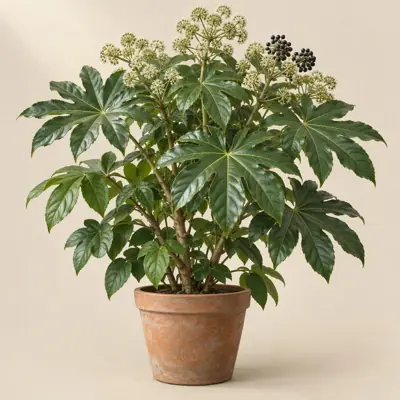
Fatsia japonica is an evergreen perennial woody plant, growing as a spreading shrub to small tree with stout, sparsely branched stems.
Overview
Fatsia japonica is an evergreen perennial woody plant, growing as a spreading shrub to small tree with stout, sparsely branched stems.
Origin and habitat
Sources differ on its native range, describing Japan and Korea, with major accounts particularly identifying southern Japan and southern Korea. It is reported from shaded habitats such as mountain forests and forest understories near coasts in warm areas, including cool, somewhat moist settings. It is suited to warm-temperate to subtropical conditions and can also be grown in cooler areas with suitable shelter and within its cold tolerance.
Characteristics
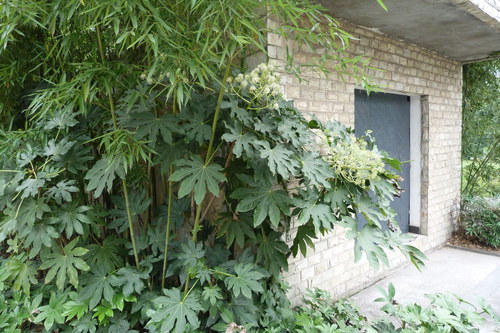
Sources differ on mature height, giving a range of about 250–600 cm, while a single source reports a mature spread of about 250–400 cm. The leaves are large, deep green to glossy, leathery, and deeply palmately lobed, with long petioles. The small flowers are white to creamy white or greenish white and are clustered in terminal compound umbel-like or paniculate inflorescences; flowering occurs from autumn into early winter. Sources differ in their descriptions of the small, nearly spherical fruit, which becomes black or glossy black when mature and generally ripens from winter into the following spring.
Light
Sources differ somewhat, but partial to full shade is considered more suitable; the plant tolerates a broader range of light conditions, while strong direct sunlight may injure or scorch the leaves.
Watering
Water regularly during the growing period; it prefers moist but well-drained soil, and the surface soil can be allowed to dry slightly before watering again. Reduce watering in winter; established mature plants have some drought tolerance.
Humidity and airflow
It is reported to prefer high humidity and needs little air movement.
Temperature and dormancy
Sources differ, with limited evidence placing the lower temperature at about -15 °C. Sources differ on the stated hardiness classification, while the plant is generally reported to tolerate brief light frost.
Growing medium and mounting
It does best in acidic, moist, well-drained, humus-rich, fertile soil, but can also adapt to sandy and clay soils and to chalk, loam, and acidic, neutral, or alkaline conditions.
Feeding
It is generally reported to benefit from regular feeding during the growing period, with feeding stopped in winter.
Propagation
It is reported to be propagated by seed; mature seed can be kept slightly moist and then buried or refrigerated before sowing in autumn or the following spring.
Common problems
Outdoors, exposure to full sun or strong wind may scorch or brown the leaves, and hard frost may also damage them. A sheltered position is suitable; outdoor sun and wind exposure can cause leaf browning, while the plant tolerates light frost.
Identification
Fatsia japonica is an evergreen shrub distinguished by its conspicuous large, glossy, deeply lobed palmate leaves, with clusters of small white flowers in late autumn followed by black fruit.
Photos



Sources
- GBIF Backbone: Fatsia japonica (Thunb.) Decne. & Planch. — CC BY 4.0 · link
- Wikipedia (en): Fatsia japonica — CC BY-SA 4.0 · link
- 維基百科:八角金盤 — CC BY-SA 4.0 · link
- Wikipedia (ja): ヤツデ — CC BY-SA 4.0 · link
- Wikipedia (de): Zimmeraralie — CC BY-SA 4.0 · link
- Wikipedia (fr): Fatsia japonica — CC BY-SA 4.0 · link
- Wikipedia (es): Fatsia japonica — CC BY-SA 4.0 · link
- NC State Plant Toolbox: Fatsia japonica — copyright (facts only) · link
- Wikipedia (it): Fatsia japonica — CC BY-SA 4.0 · link
- Wikipedia (nl): Vingerplant — CC BY-SA 4.0 · link
- Wikipedia (ko): 팔손이 — CC BY-SA 4.0 · link
- RHS Plants: Fatsia japonica — © RHS, facts only · link
- Top Tropicals catalog: Fatsia japonica — © Top Tropicals LLC (facts only) · link