
Mexican lime cactus (Ferocactus pilosus)
Ferocactus pilosus is an evergreen perennial succulent cactus with a barrel-shaped to columnar habit; it may grow singly or form large clumps, with young plants more nearly globose before becoming upright, barrel-shaped to columnar with age.
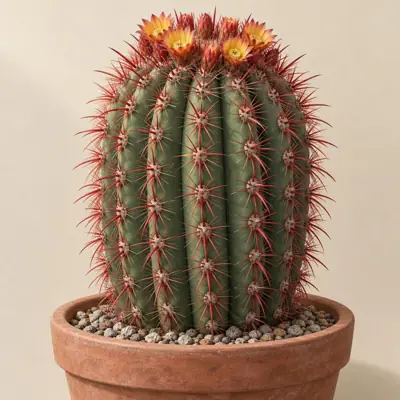
Overview
Ferocactus pilosus is an evergreen perennial succulent cactus with a barrel-shaped to columnar habit; it may grow singly or form large clumps, with young plants more nearly globose before becoming upright, barrel-shaped to columnar with age.
Origin and habitat
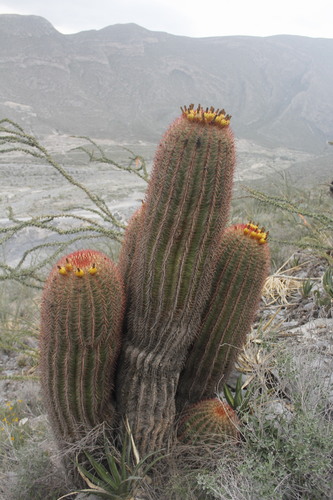
Sources agree on a native range in north-central to northeastern Mexico, including Coahuila, Durango, Nuevo León, San Luis Potosí, and Tamaulipas, while sources differ on the inclusion of Zacatecas. It occurs in semidesert, desert, and dry scrub habitats and can grow in various soils, especially on rocky limestone slopes in arid to semiarid parts of north-central Mexico.
Characteristics
Sources differ, but mature plants are reported at about 240–300 cm tall and about 30–50 cm across. Growth is initially slow but can improve under cultivation. Sources differ in their descriptions of the flowers, which are arranged in a ring near the stem apex, range from yellow to red, and are funnel-shaped; flowering is reported from early summer through summer. The fruit is yellow and ovoid, slightly fleshy, may split through an opening at the base, and retains the persistent perianth at the tip.
Light
Ferocactus pilosus takes full sun, with some afternoon shade suitable in hot areas.
Watering
Water moderately during the growing season with good drainage, allowing the growing medium to dry before watering again; reduce watering markedly during autumn and winter dormancy, keeping it nearly dry in winter and avoiding overwatering.
Humidity and airflow
It is generally reported to prefer low humidity.
Temperature and dormancy
Few sources report a cold minimum of about -4 °C. It is reported to tolerate brief light frost. Sources differ on its hardiness classification. It rests cool and dry in winter.
Growing medium and mounting
Use a fast-draining cactus or succulent mix; well-drained loam or sandy soil is also listed, while in the wild it grows in various soils and is often found on rocky limestone slopes.
Feeding
It is reported to need feeding only during the growing season, using fertilizer intended for cacti or succulents.
Propagation
Propagation is by seed, with sowing recommended in spring.
Common problems
Mealybugs are reported as a possible pest. Disease is generally reported to be uncommon, although overwatering may lead to stem and root rot. The main cultivation risks include overwatering, rot associated with poor drainage, and cold damage. It prefers arid or semiarid conditions with hot summers and can tolerate brief occasional frost, although cold is an important cultivation risk.
Identification
Ferocactus pilosus has dark green, prominently ribbed, barrel-shaped to columnar stems; its stout central spines are mostly bright red, while the radial spines are often reduced to slender white or straw-colored bristles or may be absent, and older plants can form large clumps of columns.
Photos



Sources
- Wikipedia (en): Ferocactus pilosus — CC BY-SA 4.0 · link
- Wikipedia (de): Ferocactus pilosus — CC BY-SA 4.0 · link
- Wikipedia (fr): Ferocactus pilosus — CC BY-SA 4.0 · link
- Wikipedia (es): Ferocactus pilosus — CC BY-SA 4.0 · link
- LLIFLE Encyclopedia of living forms: Ferocactus pilosus — CC BY-SA · link
- Useful Tropical/Temperate Plants: Ferocactus pilosus — CC BY-NC-SA 3.0 (facts only) · link
- RHS Plants: Ferocactus pilosus — © RHS, facts only · link
- The Succulent Plant Page: Ferocactus (genus-level) — © R.J. Hodgkiss, facts only · link
- NC State Plant Toolbox: Ferocactus (genus-level) — copyright (facts only) · link
- PUKUBOOK: Ferocactus pilosus — CC BY-NC (facts only) · link