
Fig (Ficus carica)
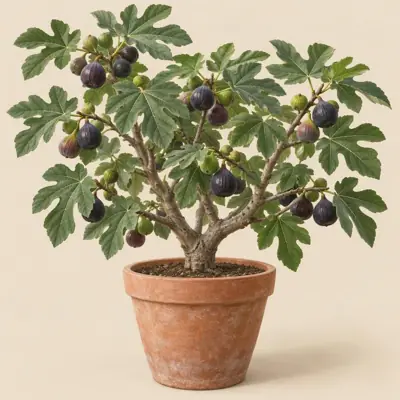
Ficus carica is a perennial deciduous woody plant that may grow as a shrub or small tree, with many branches and a spreading crown.
Overview
Ficus carica is a perennial deciduous woody plant that may grow as a shrub or small tree, with many branches and a spreading crown.
Origin and habitat
Its native range is mainly described as extending from western to central Asia and around the Mediterranean, although sources differ on its extension eastward, into North Africa, and into southeastern Europe. It grows in rocky places, woodland, and scrub with hot, dry soils and can also adapt to drier regions. It is suited to temperate to subtropical environments, preferring a relatively dry climate with alternating cool and hot seasons, and tolerates some seasonal drought.
Characteristics
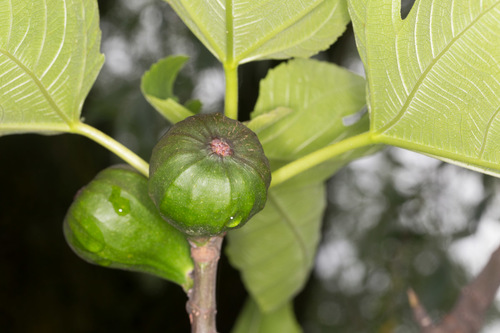
Sources differ on mature height, placing it at about 300–1000 cm, while mature spread is 250–910 cm; growth is moderate to fast. The large, alternate leaves are deeply palmately lobed, may have a rough or hairy surface, and are shed in winter. Many tiny flowers occur inside a hollow, fleshy syconium with a small opening, so they are difficult to see from outside; flowering is generally reported for part of the year. The syconium may be pear-shaped, obovoid, or nearly bulb-shaped, with mature colors varying by cultivar among green, purple, and brown tones, and it generally matures from late summer into autumn.
Light
Full sun is best; some sources also allow partial sun or bright indoor light, while cultivation for fruiting favors ample sunlight.
Watering
Water moderately and keep the growing medium moist but well drained, although the plant can adapt to drier soil; watering after the surface soil dries and avoiding persistently wet, waterlogged conditions are suitable practices.
Temperature and dormancy
Sources are few and differ on minimum temperature, reporting about -15 °C. A single source reports an ideal temperature of about 16–26 °C and a maximum of about 38 °C. Hardiness classifications are reported in the cited systems, and the plant is generally reported to be frost hardy.
Growing medium and mounting
Well-drained loamy, sandy, or calcareous soils are suitable, but sources differ on the appropriate pH, ranging in description from acidic or neutral conditions to neutral or alkaline conditions.
Propagation
Ficus carica can be propagated by stem cuttings, layering, or suckers.
Common problems
Ambrosia beetles are reported as potential pests, and fig-related diseases are also reported, although the supplied source text does not specify particular disease names. Excessively wet, heavy soil may promote vegetative growth at the expense of fruiting, while abundant suckers may form dense thickets. Young plants and tender above-ground shoots are sensitive to frost, and severe winters may cause above-ground growth to die back to the base; in colder regions winter protection may be needed, and warm, sheltered positions are suitable.
Identification
Ficus carica is generally distinguished by large palmately lobed leaves, white milky sap released when branches or leaves are injured, and flowers concealed within a fleshy syconium, giving the appearance of producing fruit without visible flowering.
Photos


Sources
- Wikipedia (en): Fig — CC BY-SA 4.0 · link
- 維基百科:無花果 — CC BY-SA 4.0 · link
- Wikipedia (ja): イチジク — CC BY-SA 4.0 · link
- Wikipedia (de): Echte Feige — CC BY-SA 4.0 · link
- Wikipedia (fr): Ficus carica — CC BY-SA 4.0 · link
- Wikipedia (es): Ficus carica — CC BY-SA 4.0 · link
- GBIF descriptions: Manual of the Alien Plants of Belgium; Inventory of the urban flora of Budapest (Hungary) highlighti — per dataset · link
- NC State Plant Toolbox: Ficus carica — copyright (facts only) · link
- Wikipedia (nl): Vijgenboom — CC BY-SA 4.0 · link
- TaiCOL 臺灣物種名錄: Ficus carica — CC BY 4.0 · link
- Useful Tropical/Temperate Plants: Ficus carica — CC BY-NC-SA 3.0 (facts only) · link
- RHS Plants: Ficus carica — © RHS, facts only · link
- USDA PLANTS Database: Ficus carica — Public domain (US Government work) · link
- Top Tropicals catalog: Ficus carica — © Top Tropicals LLC (facts only) · link