
Indian rubberplant (Ficus elastica)
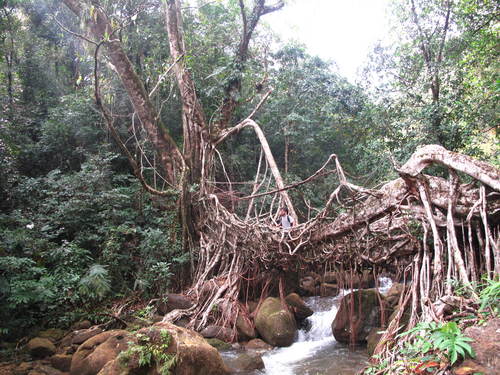
Ficus elastica is a large perennial evergreen tree that is often grown indoors for its foliage; in the wild it can have a semi-epiphytic, strangling growth habit.
Overview
Ficus elastica is a large perennial evergreen tree that is often grown indoors for its foliage; in the wild it can have a semi-epiphytic, strangling growth habit.
Origin and habitat
Ficus elastica is native from southern Asia into Southeast Asia, with accounts commonly including northeastern India, Nepal, Bhutan, Myanmar, Malaysia, and Indonesia, while sources differ on whether Bangladesh, Thailand, and Yunnan in China are also included. Its natural habitats include forests, particularly montane forests, cliffs, and limestone hills, and young plants may also grow epiphytically on other trees. Native to tropical Asia, it is adapted to tropical environments ranging from dry to humid; it can be grown outdoors in warm regions and is usually grown indoors in colder or temperate regions.
Characteristics
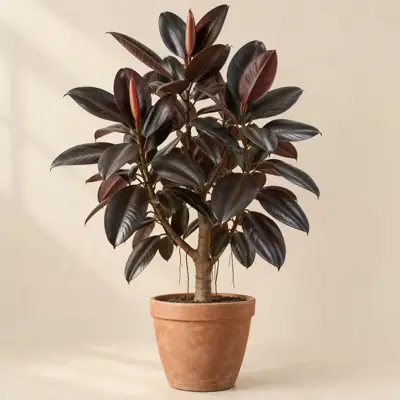
Sources differ on mature height, placing it at about 250–400 cm, while the few available sources report a mature spread of about 100–150 cm. The leaves are thick, leathery, glossy, entire, and elongated to broadly elliptic; the typical form is usually dark green, young plants generally have larger leaves, 'Abidjan' has red-black foliage, and new leaves are enclosed by a sheath-like structure before unfolding. The flowers occur within fig-like inflorescences and depend on specific fig wasps for pollination rather than attracting general pollinators with bright colors or strong fragrance; flowering is rare indoors. Mature plants can form small, elliptic, yellow-green figs, and sources differ on the account that production of viable seed is associated with the presence of specific fig wasps.
Light
Sources differ somewhat, but Ficus elastica is described as growing in bright filtered or indirect light to partial sun and tolerating some low light, while strong direct sunlight can scorch the leaves.
Watering
Water regularly during active growth while avoiding overwatering and waterlogging; the surface of the growing medium can be allowed to dry before watering thoroughly, with watering reduced during dormancy while avoiding prolonged complete drying.
Humidity and airflow
It is generally reported to prefer moderate humidity and to need little air movement.
Temperature and dormancy
The few available sources place the minimum temperature at about 13 °C. It is described as suitable for warm hardiness conditions, and it is frost tender; keep above freezing.
Growing medium and mounting
A well-drained potting medium is suitable; sources describe indoor plant potting mix kept moist but well drained, with acidic, neutral, or alkaline conditions all acceptable.
Feeding
Sources differ on feeding details, but describe fertilizing during active growth, with recommendations including high-nitrogen fertilizer or primarily liquid fertilizer; excessive feeding under favorable conditions may promote excessive plant size or cause roots to fill the container more quickly.
Propagation
Ficus elastica can be propagated by cuttings or layering, with cultivated plants commonly propagated vegetatively using cuttings and air layering.
Common problems
Indoor or greenhouse plants may be affected by scale insects, mealybugs, thrips, and spider mites. Armillaria-related disease may occur, while poor drainage or watering management may be associated with root rot. Reported cultivation problems include overwatering, roots filling the container, elongated growth from insufficient light, and leaf scorch from strong direct sunlight. The plant is sensitive to frost and low temperatures and should be protected from cold drafts; young or indoor-grown plants should also avoid excessively strong direct sunlight.
Identification
'Abidjan' is generally reported to be a cultivar of Ficus elastica arising as a bud sport of 'Decora'; its most distinctive feature is its red-black foliage, and it also has the thick, glossy leaves and milky sap typical of Ficus elastica.
Photos


Sources
- Wikipedia (en): Ficus elastica — CC BY-SA 4.0 · link
- 維基百科:印度榕 — CC BY-SA 4.0 · link
- Wikipedia (ja): インドゴムノキ — CC BY-SA 4.0 · link
- Wikipedia (de): Gummibaum — CC BY-SA 4.0 · link
- Wikipedia (fr): Ficus elastica — CC BY-SA 4.0 · link
- Wikipedia (es): Ficus elastica — CC BY-SA 4.0 · link
- NC State Plant Toolbox: Ficus elastica — copyright (facts only) · link
- TaiCOL 臺灣物種名錄: Ficus elastica — CC BY 4.0 · link
- Useful Tropical/Temperate Plants: Ficus elastica — CC BY-NC-SA 3.0 (facts only) · link
- RHS Plants: Ficus elastica — © RHS, facts only · link
- USDA PLANTS Database: Ficus elastica — Public domain (US Government work) · link
- Top Tropicals catalog: Ficus elastica — © Top Tropicals LLC (facts only) · link