
Fiddle-leaf Fig (Ficus lyrata)
Ficus lyrata is a perennial evergreen tree or shrub and is commonly grown indoors as a large foliage tree.
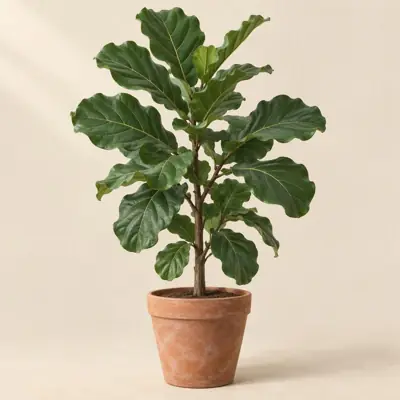
Overview
Ficus lyrata is a perennial evergreen tree or shrub and is commonly grown indoors as a large foliage tree.
Origin and habitat
Sources differ on its native range, describing it as native to tropical West and Central Africa and listing native countries in those regions. Its habitat includes tropical rainforest and moist lowland forest. It is native to tropical climates and can be grown outdoors in tropical and subtropical climates, while in temperate regions it is mainly grown indoors or in greenhouses and does not tolerate frost or prolonged cold.
Characteristics
Sources differ and are few, but mature height is reported at about 900–1600 cm; a single source reports a mature spread of about 100–150 cm. The large, leathery leaves are dark green to glossy, often fiddle- or lyre-shaped with a narrower middle, broader tip, prominent veins, and wavy margins. The flowers are small and occur mainly on outdoor plants, with flowering uncommon in container-grown or indoor plants. Sources differ in their descriptions of the green fig fruits, while indoor or container-grown plants generally do not fruit.
Light
Sources differ, supporting conditions from bright indirect or filtered light to full sun; indoors, provide abundant bright light while avoiding intense direct afternoon exposure.
Watering
Keep the growing medium moist but well drained, allowing the potting medium to dry partially between waterings and avoiding prolonged waterlogging or overwatering; watering may be more frequent during hot periods. In winter, the watering interval is 10–14 days.
Humidity and airflow
It is generally reported to prefer moderate humidity.
Temperature and dormancy
Sources differ and are few on minimum temperature, with about 10 °C reported. A source reports a USDA hardiness-zone classification. It is frost tender; keep above freezing.
Growing medium and mounting
It prefers a moist but well-drained, humus-rich or loamy medium, although sources differ and report adaptation to clay, loam, sand, and chalk and to acidic, neutral, or alkaline conditions.
Feeding
It is generally reported not to require heavy feeding.
Propagation
It can be propagated by stem, tip, leaf-bud, or semi-hardwood cuttings, as well as by air layering, division, or seed.
Common problems
Potential pests include glasshouse red spider mite, thrips, mealybugs, and scale insects, with glasshouse thrips and fern scale also listed as problems. Potential diseases or disorders include honey fungus and root rot associated with prolonged overwatering. Overwatering may cause root rot, lack of water may cause leaves to dry or wilt, frequent relocation may stress the plant and cause leaf drop, and intense indoor afternoon sun may damage leaves. It is sensitive to frost, cold, and intense afternoon exposure; in cold regions it should be moved indoors in winter, and outdoor plantings should be sheltered from wind.
Identification
Its most conspicuous features are its large, leathery, prominently veined, fiddle-shaped leaves with wavy margins.
Photos


Sources
- Wikipedia (en): Ficus lyrata — CC BY-SA 4.0 · link
- Wikipedia (de): Geigen-Feige — CC BY-SA 4.0 · link
- Wikipedia (fr): Ficus lyrata — CC BY-SA 4.0 · link
- Wikipedia (es): Ficus lyrata — CC BY-SA 4.0 · link
- NC State Plant Toolbox: Ficus lyrata — copyright (facts only) · link
- Wikipedia (it): Ficus lyrata — CC BY-SA 4.0 · link
- Wikipedia (nl): Vioolbladplant — CC BY-SA 4.0 · link
- Wikipedia (pt): Ficus lyrata — CC BY-SA 4.0 · link
- TaiCOL 臺灣物種名錄: Ficus lyrata — CC BY 4.0 · link
- RHS Plants: Ficus lyrata — © RHS, facts only · link
- USDA PLANTS Database: Ficus lyrata — Public domain (US Government work) · link
- Top Tropicals catalog: Ficus lyrata — © Top Tropicals LLC (facts only) · link
- PLNTS care guide: Ficus lyrata — © PLNTS (facts only) · link