
Fiddle-leaf Fig (Ficus lyrata)
Ficus lyrata is a perennial evergreen woody plant that can grow as a tree or shrub and is commonly grown indoors as a large foliage plant.
Overview
Ficus lyrata is a perennial evergreen woody plant that can grow as a tree or shrub and is commonly grown indoors as a large foliage plant.
Origin and habitat
Ficus lyrata is native to tropical West and Central Africa; sources differ on the full native range, but collectively include Cameroon, Benin, Ivory Coast, Gabon, Liberia, Nigeria, Sierra Leone and Togo, with some also listing Ghana, Guinea and Guinea-Bissau. Its habitat is humid tropical lowland rainforest. It is native to tropical climates and can be grown outdoors as an ornamental tree in tropical and subtropical regions, while in temperate regions it is more often grown indoors or in greenhouses.
Characteristics
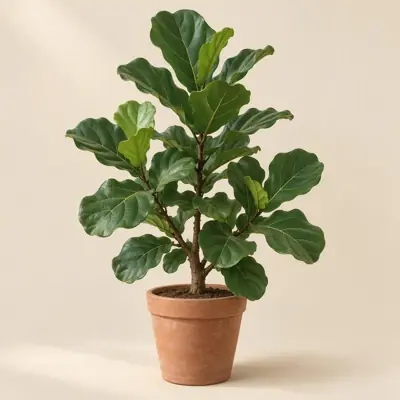
Sources differ on mature height, placing it at about 61–305 cm, while a single source reports a mature spread of about 100–150 cm. The large, dark green to green leaves are leathery, prominently veined and wavy-edged, typically with a broad top and narrower middle that gives them a fiddle- or harp-like shape. It can produce small flowers within the enclosed inflorescence structure of the fig, but flowering is rare in potted or indoor plants. Mature plants can form green figs, although sources differ in their descriptions, and fruiting is generally rare indoors or in containers.
Light
Sources differ somewhat on light: indoors, bright indirect or filtered strong light is suitable, and the plant can also tolerate partial shade and some direct sunlight; strong afternoon sun should be avoided.
Watering
Keep the growing medium moderately moist but well drained, allowing the surface or part of the soil to dry before watering again and avoiding prolonged wetness; in warm seasons, watering frequency should increase according to temperature. In winter, the watering interval is 10–21 days.
Humidity and airflow
It is generally reported to prefer moderate humidity.
Temperature and dormancy
Sources differ on the minimum temperature, with limited evidence placing it at about 10 °C. It is generally reported for USDA hardiness zones without a more specific numerical rendering here. It is frost tender; keep above freezing.
Growing medium and mounting
Moist but well-drained loamy or humus-rich growing media are suitable; sources differ on soil preferences, with one favoring acidic loam and another describing adaptation to acidic, neutral or alkaline conditions and to loam, clay, sand or chalk soils.
Feeding
It is generally reported not to require heavy feeding.
Propagation
Ficus lyrata can be propagated by stem, tip, leaf-bud or semi-hardwood cuttings, air layering or seed; another source also records division.
Common problems
Potential pests include spider mites, thrips, scale insects and mealybugs. It may develop honey-fungus-related disease, while prolonged overwatering can cause root rot. Overwatering can cause root rot, insufficient water can lead to dry or wilted leaves, strong afternoon sun can damage leaves, and frequent changes of position can stress the plant and cause leaf drop. It is sensitive to frost and prolonged cold, requires indoor overwintering in cold regions, and can suffer leaf damage from strong afternoon sun.
Identification
Its most distinctive features are large, leathery, prominently veined, fiddle-shaped leaves that narrow in the middle, together with an upright tree-like form.
Photos


Sources
- Wikipedia (en): Ficus lyrata — CC BY-SA 4.0 · link
- Wikipedia (de): Geigen-Feige — CC BY-SA 4.0 · link
- Wikipedia (fr): Ficus lyrata — CC BY-SA 4.0 · link
- Wikipedia (es): Ficus lyrata — CC BY-SA 4.0 · link
- NC State Plant Toolbox: Ficus lyrata — copyright (facts only) · link
- Wikipedia (it): Ficus lyrata — CC BY-SA 4.0 · link
- Wikipedia (nl): Vioolbladplant — CC BY-SA 4.0 · link
- Wikipedia (pt): Ficus lyrata — CC BY-SA 4.0 · link
- TaiCOL 臺灣物種名錄: Ficus lyrata — CC BY 4.0 · link
- RHS Plants: Ficus lyrata — © RHS, facts only · link
- USDA PLANTS Database: Ficus lyrata — Public domain (US Government work) · link
- Top Tropicals catalog: Ficus lyrata — © Top Tropicals LLC (facts only) · link
- PLNTS care guide: Ficus lyrata — © PLNTS (facts only) · link