
Creeping Fig (Ficus pumila)
Ficus pumila is a perennial evergreen woody climber or creeping plant that can spread along the ground or climb walls, rocks, and trees using aerial roots.
Overview
Ficus pumila is a perennial evergreen woody climber or creeping plant that can spread along the ground or climb walls, rocks, and trees using aerial roots.
Origin and habitat
Sources differ on its native range: it is native to East Asia, with China, Japan, and Vietnam commonly included, while some accounts also include Korea, Taiwan, and broader parts of Asia; Taiwan's species list records Ficus pumila as native to Taiwan and not endemic there. It grows on surfaces such as tree trunks and rocks and can attach to walls and stone structures; wild-habitat accounts also associate it with forest environments. It prefers warm, moist environments and can grow in tropical and subtropical conditions; outdoor cultivation should avoid frost.
Characteristics
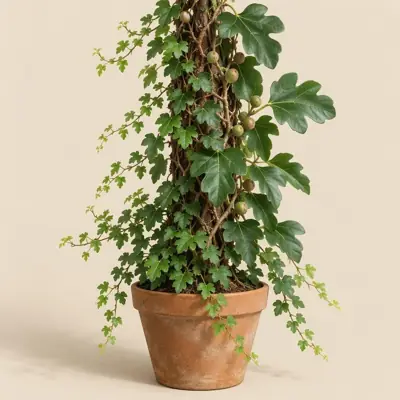
Sources differ and are few, but mature height is reported at about 250–400 cm; a single source reports a mature spread of about 150–250 cm. It grows rapidly and vigorously and can quickly cover the ground or climbing surfaces under suitable conditions. The evergreen leaves may be ovate, heart-shaped, and slightly asymmetrical; juvenile leaves are distinctly smaller and thinner than the larger, thicker mature leaves, and climbing and non-climbing shoots also differ in leaf form; 'Quercifolia' is described as oak leaf creeping fig. The small flowers are enclosed within fig-like inflorescences and are difficult to see externally, and they are pollinated by fig wasps; flowering is generally reported in early summer, while fig-like fruiting structures may mature to purple, although sources describe their size differently.
Light
Bright indirect light to partial sun is suitable for young indoor plants, while outdoors it can grow from partial to full sun where moisture is sufficient and drainage is good; some sources report that strong light can damage juvenile leaves.
Watering
Water regularly and relatively generously during the growing season, keeping the growing medium moist but well drained; reduce watering from autumn through late winter while avoiding prolonged complete drying.
Humidity and airflow
Ficus pumila prefers high humidity.
Temperature and dormancy
Sources differ and are few, but the reported minimum temperature is about 1 °C. A single source reports a USDA hardiness-zone classification and generally indicates that Ficus pumila tolerates brief light frost.
Growing medium and mounting
Use a humus-rich growing medium that remains moist but drains well; the plant can adapt to various soils, and a loam-based potting medium is suitable indoors.
Feeding
A single source reports that liquid fertilizer can be applied from spring through autumn, with periodic feeding recommended by a Japanese source.
Propagation
A single source reports propagation by seed, leaf-bud cuttings, or semi-hardwood cuttings.
Common problems
In greenhouse or indoor conditions, spider mites, thrips, mealybugs, and scale insects may occur, with NC State additionally listing greenhouse thrips pests. Honey fungus caused by Armillaria may occur, according to a single source. Overly vigorous growth can become invasive, and aerial attachment roots on buildings can damage fragile plaster, wooden surfaces, or other delicate materials; strong light may also injure foliage grown for ornamental display. It does not tolerate frost, and severe cold may kill above-ground climbing growth; sheltered, frost-free conditions are preferred outdoors.
Identification
Juvenile and mature leaves are distinctly different, while slender stems attach to supports with numerous short aerial roots and may release milky sap when injured; sources list 'Quercifolia' as the oak-leaf form or oak leaf creeping fig.
Photos


Sources
- Wikipedia (en): Ficus pumila — CC BY-SA 4.0 · link
- 維基百科:薜荔 — CC BY-SA 4.0 · link
- Wikipedia (ja): オオイタビ — CC BY-SA 4.0 · link
- Wikipedia (fr): Ficus pumila — CC BY-SA 4.0 · link
- Wikipedia (es): Ficus pumila — CC BY-SA 4.0 · link
- NC State Plant Toolbox: Ficus pumila — copyright (facts only) · link
- TaiCOL 臺灣物種名錄: Ficus pumila — CC BY 4.0 · link
- Useful Tropical/Temperate Plants: Ficus pumila — CC BY-NC-SA 3.0 (facts only) · link
- RHS Plants: Ficus pumila — © RHS, facts only · link
- USDA PLANTS Database: Ficus pumila — Public domain (US Government work) · link
- Top Tropicals catalog: Ficus pumila — © Top Tropicals LLC (facts only) · link