
mosaic-plant (Fittonia albivenis)
Fittonia albivenis is a low, creeping, trailing herb that can form dense ground cover. It is an evergreen perennial herb.
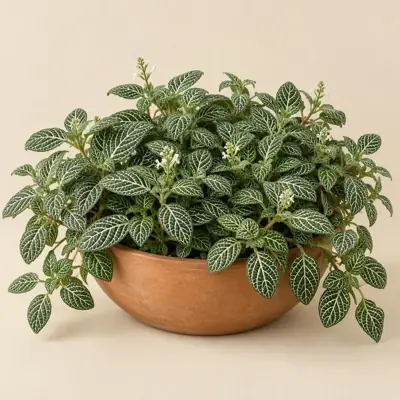
Overview
Fittonia albivenis is a low, creeping, trailing herb that can form dense ground cover. It is an evergreen perennial herb.
Origin and habitat
It is native to tropical South America, including Colombia, Peru, Bolivia, Ecuador, and northern Brazil; sources differ on whether Venezuela is also included in its range. It occurs in tropical rainforest or dense forest, with records from different elevations. Its environment is warm and humid, with high atmospheric humidity, and it does not tolerate low temperatures.
Characteristics
Sources differ on mature height, reporting about 8–20.32 cm. Based on few sources, mature spread is reported at about 45.72–45.72 cm. The leaves are green to dark green and ovate to narrowly elongated, often with conspicuous white, silvery white, pink, or red veins. The flowers are small and inconspicuous and borne in spikes; sources differ in describing their color as white to creamy white or yellow.
Light
Sources describe it as suited to gentle, bright to moderate indirect light and able to adapt to shadier conditions, while direct sunlight should be avoided.
Watering
Water regularly and keep the growing medium moist but well drained; after being dry for several days, the plant wilts noticeably but usually recovers quickly after watering.
Humidity and airflow
Fittonia albivenis prefers high humidity.
Temperature and dormancy
Sources differ, with a minimum temperature of about 13 °C reported. It is generally reported as belonging to the USDA hardiness range.
Growing medium and mounting
Use a fertile growing medium; a peat-based medium can be used, with moist but well-drained conditions preferred.
Propagation
It can be propagated by division or seed, and its creeping stems can root on their own.
Common problems
The provided source generally reports no specific diseases. An overly dry growing medium can cause rapid, conspicuous wilting, while dry air, airflow, or direct sunlight can cause leaves to shrivel or drop. It is reported to be sensitive to low temperatures and dryness, and in temperate low-temperature conditions it needs to be moved indoors or grown in a protected place.
Identification
Its most distinctive features are strongly contrasting white, silvery white, pink, or red netted veins on green leaves and its low, creeping growth habit.
Photos


Sources
- Wikipedia (en): Fittonia albivenis — CC BY-SA 4.0 · link
- 維基百科:網紋草 — CC BY-SA 4.0 · link
- Wikipedia (de): Fittonia albivenis — CC BY-SA 4.0 · link
- Wikipedia (fr): Fittonia albivenis — CC BY-SA 4.0 · link
- Wikipedia (es): Fittonia verschaffeltii — CC BY-SA 4.0 · link
- GBIF descriptions: Catálogo de Plantas y Líquenes de Colombia; Listado de plantas de uso y aprovechamiento sostenible e — per dataset · link
- NC State Plant Toolbox: Fittonia albivenis — copyright (facts only) · link
- Useful Tropical/Temperate Plants: Fittonia albivenis — CC BY-NC-SA 3.0 (facts only) · link