
Hottentot Bread (Fockea edulis)
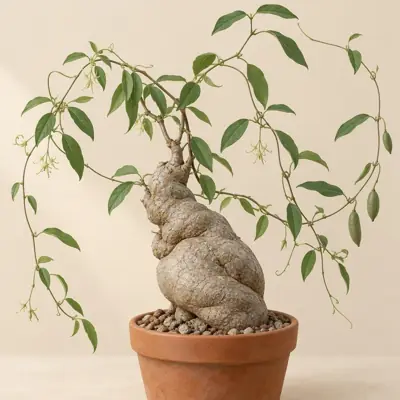
Fockea edulis is a perennial, succulent, caudiciform climbing vine that may be semi-deciduous or deciduous depending on growing conditions.
Overview
Fockea edulis is a perennial, succulent, caudiciform climbing vine that may be semi-deciduous or deciduous depending on growing conditions.
Origin and habitat
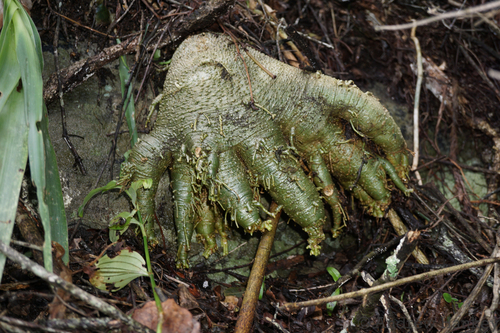
Sources differ on its southern African range: South Africa is the main area of distribution, with records from the Northern Cape, Western Cape, and KwaZulu-Natal; several sources also record Namibia, while another records Botswana. It occurs in succulent scrub, dry savanna, and rocky slopes in warm, dry regions, where the tuber is often partly or completely buried. It is associated with relatively dry subtropical to warm, dry southern African climates, is drought tolerant, and withstands only brief light frost.
Characteristics
Sources differ on mature height, giving about 300–400 cm, while mature spread is 30–60 cm; the plant has a tuber, with vigorous vines and a tuber that enlarges faster when buried. The green, entire leaves are elliptic to oblong; some sources describe them as smooth and glossy and usually occurring in pairs. Sources differ in their descriptions of the small, inconspicuous, pale cream-white to greenish-white flowers, which have a faint sweet fragrance; the species is dioecious and fly-pollinated, with flowering from late summer to early autumn. The fruits are gray to gray-green and pod-like, and the plant develops a large tuber with long vine branches.
Light
Sources differ between recommending full sun and bright partial sun, but the enlarged tuber should be shaded, and strong midday sun can be avoided in hot conditions.
Watering
During active growth it can be watered regularly and supplied with ample water; while in leaf, keep evenly moist. In winter it should be kept relatively dry, with only enough water to prevent the tuber from shriveling, and the surface of the growing medium may be allowed to dry somewhat before watering again; water sparingly while leafless.
Temperature and dormancy
The reported minimum is -2 °C, and it tolerates brief light frost. Sources differ on its hardiness-zone classification. Dormancy varies, and one specialist source reports that dormancy is triggered by cold. It is reported to have high heat tolerance.
Growing medium and mounting
It adapts to various soils but requires very good drainage; another recommendation is a growing medium containing sand or gravel with a small amount of humus. A specialist source reports that it needs a very fast-draining mix.
Feeding
It can be fertilized during summer growth, and a commercial horticultural source recommends a relatively high-nitrogen fertilizer during active growth to encourage tuber growth.
Propagation
Sources differ on propagation: seed is described as the best method and as germinating readily, while success from cuttings is described as limited to very difficult. Cuttings are also listed as a propagation method.
Common problems
Pests are generally uncommon outdoors, but whiteflies may occur in humid greenhouses, and mealybugs and aphids may also cause problems. A specialist source reports that rot may occur with improper management. Excess winter moisture can increase the risk of rot, vines can readily tangle with neighboring plants, and humid greenhouse conditions favor whiteflies. It tolerates only brief light frost, while severe or prolonged frost should be avoided.
Identification
Fockea edulis has a thick, gray, enlarged tuber that in the wild is often partly or completely buried and may bear small wart-like projections; slender, twining vine stems emerge from its top.
Photos


Sources
- Wikipedia (en): Fockea edulis — CC BY-SA 4.0 · link
- Wikipedia (es): Fockea edulis — CC BY-SA 4.0 · link
- LLIFLE Encyclopedia of living forms: Fockea edulis — CC BY-SA · link
- Useful Tropical/Temperate Plants: Fockea edulis — CC BY-NC-SA 3.0 (facts only) · link
- Desert-Tropicals: Fockea edulis — © Philippe Faucon (desert-tropicals.com), facts only · link
- The Succulent Plant Page: Fockea (genus-level) — © R.J. Hodgkiss, facts only · link
- Top Tropicals catalog: Fockea edulis — © Top Tropicals LLC (facts only) · link
- Fockea edulis | Kumbula Indigenous Nursery (kumbulanursery.co.za) — facts only (§12) · link
- PUKUBOOK: Fockea edulis — CC BY-NC (facts only) · link
- Fockea edulis 'Starter' - Araflora (www.araflora.com) — facts only (§12) · link
- Buy Fockea Edulis | Unusual Succulent Shrub | Planet Desert (planetdesert.com) — facts only (§12) · link
- Fockea edulis | Giromagi cactus and succulents for sale | Buy plants online (www.giromagi.com) — facts only (§12) · link