
weeping forsythia (Forsythia suspensa)
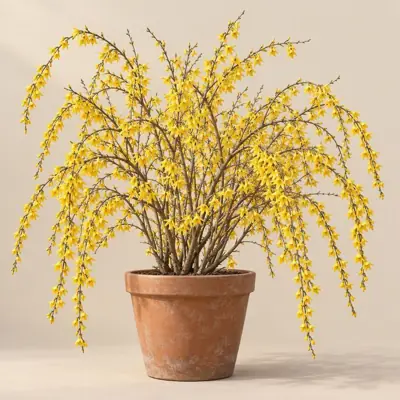
Forsythia suspensa is a perennial deciduous shrub with many branches and an upright to arching or pendent, somewhat spreading habit.
Overview
Forsythia suspensa is a perennial deciduous shrub with many branches and an upright to arching or pendent, somewhat spreading habit.
Origin and habitat
Sources differ on its native range, describing it as native to China, mainly in central and eastern China, including Anhui, Hebei, Henan, Hubei, Shaanxi, Shandong, Shanxi, and Sichuan. In the wild it occurs in scrub, grassy slopes, hillsides, valleys and ravines, as well as grasslands and dry woodlands. It is a plant of China's temperate climate, favoring relatively warm conditions while tolerating cold and some drought.
Characteristics
Sources differ on mature height, placing it at about 250–400 cm, while a single source reports a mature spread of about 250–400 cm. Growth is moderate to fast, though slower at the seedling stage; the deciduous green leaves are opposite and usually simple, ranging from ovate and long-ovate to broadly ovate with serrated margins, while some are lobed or divided into leaflets. Yellow to golden-yellow flowers commonly open before the leaves, with a lobed corolla and orange-red to red markings inside; flowering occurs in early spring. Sources differ in accounts of the fruit, which is described as a narrow-ovate to elliptic, slightly flattened capsule with a short beak that splits open when mature and contains many narrow-elliptic seeds.
Light
Full sun is preferred, although Forsythia suspensa can also grow in partial sun to shadier conditions; ample sunlight favors flowering and fruiting.
Watering
Sources differ in their descriptions of water needs, but well-drained, moderately moist soil is preferred; the plant can adapt to drier conditions and has some drought tolerance, while standing water should not be the main growing condition.
Temperature and dormancy
A single source reports a minimum temperature of about -25 °C.
Growing medium and mounting
Forsythia suspensa adapts to various soils, including sandy, loamy, clay, and calcareous soils, while well-drained, relatively fertile or humus-rich soil is preferred; it tolerates acidic, neutral, and alkaline soils.
Propagation
Forsythia suspensa can be propagated by cuttings, including summer cuttings from young shoots and semi-hardwood cuttings.
Common problems
No clearly known insect pests are reported, although RHS notes that birds may peck at flower buds. Sources differ on disease problems: some horticultural sources report honey-fungus-related disease and forsythia gall, while another source records no known pest or disease problems. In heavier shade, shoots can become elongated, while arching branches that contact the ground can root and form spreading colonies. The plant tolerates cold, its flowers resist frost, and some sources also describe it as drought tolerant; overall, it can adapt to relatively harsh winter conditions.
Identification
Forsythia suspensa is distinguished by long, flexible branches that often arch or hang markedly and by yellow flowers that open in early spring on branches before the leaves emerge; branches touching the ground can root and form spreading colonies.
Photos


Sources
- Wikipedia (en): Forsythia suspensa — CC BY-SA 4.0 · link
- 維基百科:连翘 — CC BY-SA 4.0 · link
- Wikipedia (de): Hänge-Forsythie — CC BY-SA 4.0 · link
- Wikipedia (fr): Forsythia suspensa — CC BY-SA 4.0 · link
- Wikipedia (es): Forsythia suspensa — CC BY-SA 4.0 · link
- NC State Plant Toolbox: Forsythia suspensa — copyright (facts only) · link
- 農業知識入口網 植物圖鑑: Forsythia suspensa — © MOA, facts only · link
- Useful Tropical/Temperate Plants: Forsythia suspensa — CC BY-NC-SA 3.0 (facts only) · link
- RHS Plants: Forsythia suspensa — © RHS, facts only · link
- USDA PLANTS Database: Forsythia suspensa — Public domain (US Government work) · link