
Garden Strawberry (Fragaria × ananassa)
Fragaria ananassa is reported to be an herbaceous plant.
Track your Garden Strawberry in the PLNTverse app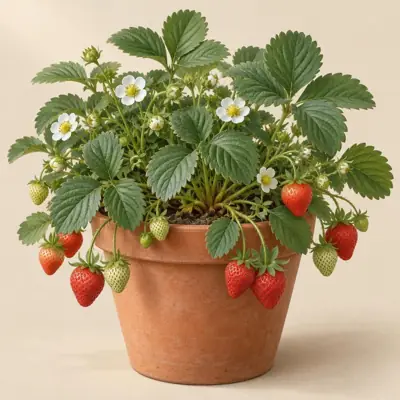
Overview
Fragaria ananassa is reported to be an herbaceous plant.
Origin and habitat
Sources differ in describing its cultivated hybrid origin, involving Fragaria virginiana from eastern North America and Fragaria chiloensis from Chile, with the hybrid arising in Brittany, France. It occurs mainly in cultivated settings, including agricultural and horticultural land, gardens, and parks; records of introduced plants also include grassland, tall-herb vegetation, broadleaf forest, coniferous forest, mixed forest, and some artificial environments. It is reported to be cultivated outdoors and in greenhouses; colder regions also use perennial bed or ridge systems, while Florida has a natural winter production season.
Characteristics
The fruit is reported to be a red, juicy aggregate accessory fruit with sweetness and aroma, and botanically is not a true berry; the seed-like structures on its surface are achenes, each containing a seed.
Propagation
It is reported to be propagated vegetatively by runners, while seeds, bare-root plants, or plug plants may also be used for propagation or to establish cultivated plants.
Common problems
Reported pests include moths, fruit flies, scarab beetles, strawberry root weevils, thrips, strawberry sap beetles, strawberry crown moths, mites, aphids, and non-arthropod pests such as slugs; the strawberry aphid Chaetosiphon fragaefolii is reported to transmit strawberry mild yellow edge virus. Reported problems include powdery mildew, leaf spot, leaf blight, slime-mold-associated infection, red stele root rot, Verticillium wilt, black root rot, nematode damage, fruit gray mold, Rhizopus rot, and leather rot. Plants under stress are reported to be more susceptible to various diseases, while fruit may be particularly damaged by rotting diseases such as gray mold.
Identification
Fragaria ananassa is reported to be a cultivated hybrid strawberry known for aromatic, bright-red, juicy, sweet fruit and able to reproduce vegetatively by runners.