
snowdrop (Galanthus nivalis)
Galanthus nivalis is a bulbous perennial herbaceous plant.
Overview
Galanthus nivalis is a bulbous perennial herbaceous plant.
Origin and habitat
Sources differ in describing its native range: it is mainly native to Europe, extending from Spain, France, and central and southern Europe eastward to the Balkans, Ukraine, and neighboring areas, while another source describes the range more broadly as Europe and southwestern Asia. It occurs in moist, cool woodland, open woodland, orchards, damp shaded grassland, and shrubby slopes, and is also widely cultivated in gardens and parks and can escape cultivation and become naturalized. It is suited to cool temperate conditions and grows and flowers from late winter into spring.
Characteristics
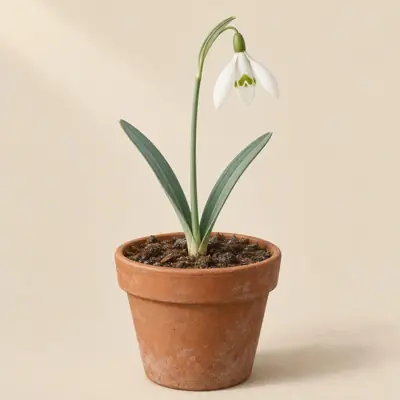
Sources differ on mature height, placing it at about 7–20 cm, while the few available sources report a mature spread of about 0–10 cm. Sources differ in their descriptions of the leaves, which are narrow, linear to strap-shaped, and gray-green to blue-green and arise from each bulb. The white, nodding, bell-shaped flowers are borne on leafless flower stalks; their outer tepals are conspicuously longer than the shorter inner tepals, whose tips usually bear green markings, and the flowers are fragrant. Sources differ on the flowering period, placing it from late winter to early spring; the fruit is reported to be an ovoid to elongated capsule that splits open into valves.
Light
It grows in full sun to partial shade, with partial shade or cool, dappled shade described as suitable.
Watering
The soil should remain moist but well drained; the plant can tolerate occasionally wetter conditions, while excessive drying should be avoided.
Temperature and dormancy
The few available sources report a minimum temperature around -15 °C. An RHS hardiness classification is reported for the plant.
Growing medium and mounting
It prefers humus-rich, moist but well-drained soil and can grow in clay, loam, sand, or chalky soils with acidic, neutral, or alkaline conditions.
Propagation
Sources differ on propagation: it can be propagated by dividing bulbs and can form colonies through seed reproduction; one source recommends separating offsets after flowering and replanting them immediately, while another also reports propagation by stem cuttings.
Common problems
It is reported to be susceptible to damage from Narcissus Bulb Fly.
Identification
Narrow, elongated gray-green leaves arise from the base of the bulb, and a leafless flower stalk bears a nodding white flower; the outer tepals are conspicuously longer than the shorter inner tepals, which have green markings.
Photos


Sources
- Wikipedia (en): Galanthus nivalis — CC BY-SA 4.0 · link
- 維基百科:雪滴花 — CC BY-SA 4.0 · link
- Wikipedia (de): Kleines Schneeglöckchen — CC BY-SA 4.0 · link
- Wikipedia (fr): Galanthus nivalis — CC BY-SA 4.0 · link
- Wikipedia (es): Galanthus nivalis — CC BY-SA 4.0 · link
- GBIF descriptions: Database of Vascular Plants of Canada (VASCAN); DAISIE - Inventory of alien invasive species in Euro — per dataset · link
- NC State Plant Toolbox: Galanthus nivalis — copyright (facts only) · link
- Useful Tropical/Temperate Plants: Galanthus nivalis — CC BY-NC-SA 3.0 (facts only) · link
- RHS Plants: Galanthus nivalis — © RHS, facts only · link
- USDA PLANTS Database: Galanthus nivalis — Public domain (US Government work) · link