
treasure-flower (Gazania rigens)
Gazania rigens is a low-growing herbaceous plant with a clumping to creeping, spreading habit. Sources describe its life cycle differently: it is a perennial herbaceous plant, but in colder regions it is often grown horticulturally as an annual flowering plant.
Overview
Gazania rigens is a low-growing herbaceous plant with a clumping to creeping, spreading habit. Sources describe its life cycle differently: it is a perennial herbaceous plant, but in colder regions it is often grown horticulturally as an annual flowering plant.
Origin and habitat
Gazania rigens is native to southern Africa, with South Africa and Mozambique explicitly included in its recorded native range. Its native range is associated with coastal areas of southern Africa, while escaped plants can also occur on coastal dunes, roadsides, and in built or transportation-associated environments. It is adapted to warm, sunny, relatively dry conditions and Mediterranean-type climates; it is half-hardy and can overwinter in regions with mild winters.
Characteristics
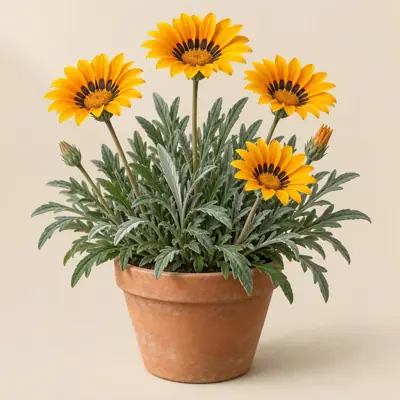
Sources differ on mature height, placing it at about 15–40 cm, while mature spread is 10–50 cm. The leaves are mostly clustered from the base and are narrow, often lance-shaped or linear, with entire or shallowly pinnately lobed margins; the upper surface ranges from green to blue-gray-green, while the underside is often grayish white and may bear white, silky hairs. The daisy-like flower heads are solitary at the tips of flowering stems, with tubular florets in the center and ray florets around them; common colors range from yellow to orange, with red, pink, white, and purple horticultural forms also occurring, and the bases of the ray florets often have black or brown markings; the flowers open in sunlight and close at night or under dark or cloudy conditions. Sources differ on flowering season: flowering is mainly from late spring through summer, but it may last longer in mild climates and some cultivars may have a longer flowering period; the fruit is an achene, described by an agricultural knowledge source as cylindrical and bearing a pappus.
Light
Gazania rigens prefers full sun; abundant sunlight supports growth and flowering, while shade, cloudy conditions, or insufficient light cause the flower heads to close.
Watering
It is drought-tolerant and prefers somewhat dry conditions; the soil surface or growing medium can be allowed to dry before watering, while prolonged waterlogging should be avoided and water should still be supplied during extended drought.
Temperature and dormancy
A single source reports an ideal temperature range of about 13–20 °C, so sources are few. Its hardiness is reported using an RHS classification.
Growing medium and mounting
Well-drained sandy loam, sand, or loam is suitable; it tolerates poor soils and a broad range of soil acidity and alkalinity, but waterlogging should be avoided.
Propagation
Gazania rigens can be propagated by seed, division, and cuttings, and another source also records plant tissue culture as a propagation method. Seeds can be sown in spring or autumn, while cutting material can be taken from basal young shoots in late summer and overwintered in frost-free conditions.
Common problems
Possible pests include mealybugs, aphids, and spider mites, with aphids requiring particular attention when plants are overwintered indoors. Possible diseases include gray mold, powdery mildew, and root, crown, or stem rots caused by Phytophthora. Overwatering or poor drainage can increase the risk of root rot, while flower heads may fail to open or may close under dark or cloudy conditions. It is half-hardy and is usually grown as an annual in colder regions; flower heads close in cloudy conditions or darkness, and NC State also notes that flowering may pause during midsummer in hot regions and resume in autumn.
Identification
Gazania rigens is low-growing and clumping, with leaves that often have grayish-white undersides and brightly colored, medal-like flower heads whose ray florets often have dark basal eye spots; the flower heads open and close in response to sunlight.
Photos


Sources
- Wikipedia (en): Gazania rigens — CC BY-SA 4.0 · link
- 維基百科:勋章菊 — CC BY-SA 4.0 · link
- Wikipedia (fr): Gazania rigens — CC BY-SA 4.0 · link
- Wikipedia (es): Gazania rigens — CC BY-SA 4.0 · link
- GBIF descriptions: Checklist of introduced taxa in Cyprus; DAISIE - Inventory of alien invasive species in Europe; Chap — per dataset · link
- NC State Plant Toolbox: Gazania rigens — copyright (facts only) · link
- 農業知識入口網 植物圖鑑: Gazania rigens — © MOA, facts only · link
- RHS Plants: Gazania rigens — © RHS, facts only · link