elegant calathea (Goeppertia concinna)
Goeppertia concinna is a clumping, upright, evergreen rhizomatous herb and an evergreen perennial.
Overview
Goeppertia concinna is a clumping, upright, evergreen rhizomatous herb and an evergreen perennial.
Origin and habitat
Sources differ on its native range, with an account placing it in Espírito Santo and Minas Gerais in southeastern Brazil. It occurs in warm, humid tropical environments with a tropical climate characterized by warmth and high humidity.
Characteristics
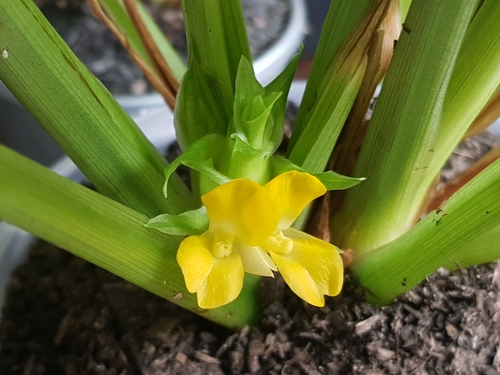
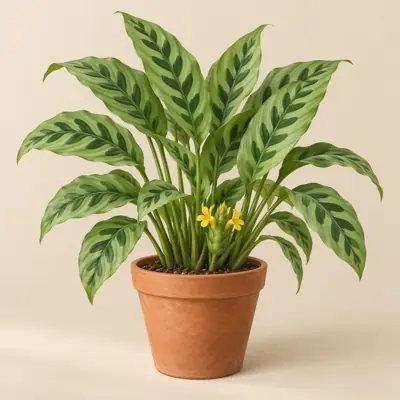
With few sources available, mature height is reported to be about 50–100 cm and mature spread about 10–50 cm. The narrow, lance-shaped to elliptic-lance-shaped leaves have pointed tips and bright to light green backgrounds, with dark green markings or broader stripes along the midrib; the petioles are long and green, with small green pulvini. The inflorescences are borne on very short stalks, consist of pointed green bracts, and have bright yellow flowers; inflorescences occur less often in cultivation.
Light
It is suited to shaded conditions with bright diffused light to medium-low indirect light and should be kept out of direct sunlight.
Watering
Keep the growing medium moist but well drained without prolonged waterlogging; distilled water or rainwater is recommended, with watering reduced slightly in winter.
Humidity and airflow
It is generally reported to prefer high humidity.
Temperature and dormancy
With few sources available, the reported minimum temperature is about 15 °C. It is generally reported for warm hardiness conditions and as frost tender; keep above freezing.
Growing medium and mounting
Use a loose, organic-rich, well-drained medium that retains moderate moisture; RHS lists loam with acidic to neutral conditions.
Feeding
Feed during the growing season; RHS recommends regular liquid houseplant fertilizer, while NC State recommends organic houseplant fertilizer at reduced strength.
Propagation
Propagate by division, including division of the rhizomes; RHS indicates this can be done in summer.
Common problems
Potential pests include greenhouse whitefly and spider mites; Goeppertia species may also have aphids, scale insects, and mealybugs. RHS considers disease generally uncommon, while Goeppertia species may develop airborne fungal diseases such as gray mold under conditions including poor ventilation. Low humidity may cause brown leaf edges; insufficient water may cause leaves to curl or yellow; overwatering and low temperatures may cause stem rot and drooping leaves; direct sunlight may scorch leaves; and unsuitable water quality may cause leaf damage or white water marks. It is sensitive to low temperatures, sudden temperature changes, and drafts and is suited to a warm, sheltered position; RHS recommends maintaining a minimum temperature above its stated threshold.
Identification
Its principal ornamental features are narrow, bright green leaves marked with dark green patterns or broad stripes, together with clustered upright petioles.
Photos