
Goeppertia roseopicta (Goeppertia roseopicta)
Goeppertia roseopicta is an evergreen perennial, rhizomatous herb with a compact, clumping, bushy habit.
Overview
Goeppertia roseopicta is an evergreen perennial, rhizomatous herb with a compact, clumping, bushy habit.
Origin and habitat
Sources differ on its native range, describing South America and, more specifically, an area from western to northwestern Brazil in the Amazon basin. It inhabits shaded tropical-rainforest understories and forest floors in a warm, humid tropical climate.
Characteristics
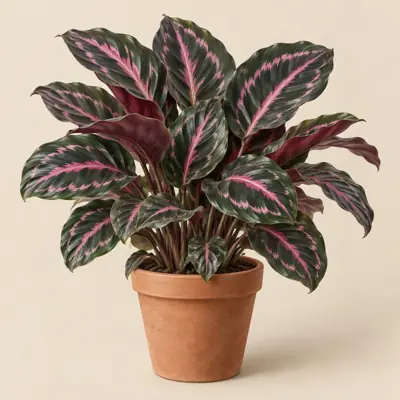
Sources differ on mature size, placing both height and spread at about 30–50 cm. The leaves have a dark green background; 'Dottie' has a pink central vein and pink feather-like markings, while the species can have softly reddish-purple to deep reddish-purple undersides and elliptic to ovate leaves. The small flowers may be white or pale purple and are less common in indoor cultivation. It is reported to possibly flower in summer.
Light
Provide bright indirect or filtered light, or partial shade, and avoid strong direct sunlight.
Watering
Keep the growing medium moist but not waterlogged during the growing period and slightly moist in winter; rainwater or distilled water can be used, and NC State advises avoiding fluoridated tap water.
Humidity and airflow
Maintain humidity at 60–100 %.
Temperature and dormancy
Maintain a minimum temperature of 16 °C. It is generally rated RHS H1A.
Growing medium and mounting
Use a moist but well-drained potting medium; NC State recommends a peaty, slightly acidic, well-drained medium and notes that vermiculite or perlite can improve drainage, while RHS also accepts a well-drained growing medium.
Feeding
Apply fertilizer monthly during the growing period; a balanced liquid fertilizer can be used.
Propagation
Propagate by dividing the rhizomes; RHS recommends doing so in late spring.
Common problems
Possible pests include spider mites, scale insects, aphids, mealybugs, and greenhouse whiteflies. Overwatering may cause root rot, while leaves remaining wet for prolonged periods or poor airflow may cause leaf spot; RHS generally rates the plant as having few disease problems. Low humidity or insufficient water is reported to cause leaf curling, while low humidity or fluoride in tap water may cause browning of leaves or leaf tips; insufficient light can fade leaf color, and direct sunlight may scorch leaves. It does not tolerate low temperatures and prefers high humidity, shelter from cold drafts, and shade.
Identification
'Dottie' is reported to have dark green leaves with a striking pink central vein and pink feather-like markings, with the leaves folding upward at night and opening again in the morning.