
Goeppertia roseopicta (Goeppertia roseopicta)
Goeppertia roseopicta is a compact, clump-forming herbaceous plant with rhizomes and is an evergreen perennial.
Overview
Goeppertia roseopicta is a compact, clump-forming herbaceous plant with rhizomes and is an evergreen perennial.
Origin and habitat
Sources differ on its native range: it is native to South America, with more specific accounts placing it in the northwestern Brazilian Amazon Basin. Its habitat is the shaded understory and darker forest floor of tropical rainforest. It is reported to occur in a warm, humid tropical climate.
Characteristics
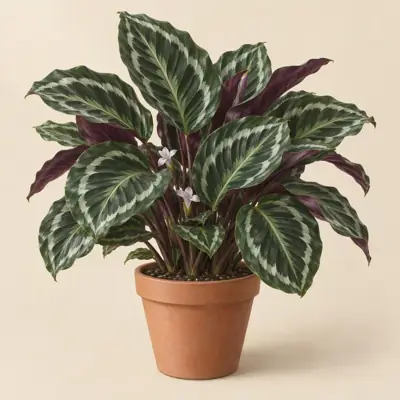
Sources differ on mature height, placing it at about 30.48–60.96 cm, while the few sources for mature spread report about 30.48–60.96 cm. The glossy, elliptical leaves are typically dark green above with pink or creamy-white markings along the midrib and veins and reddish-purple undersides; 'Medallion' is specifically described as having dark green upper surfaces with silver striping and purple undersides. The flowers are small and range from white to pale purple, and flowering is uncommon indoors. It is reported to be capable of flowering in summer.
Light
Provide bright indirect or filtered light or partial shade, and avoid strong direct light.
Watering
During the growing period, keep the growing medium moist but not waterlogged and ensure good drainage; in winter, keep it only slightly moist. Rainwater or distilled water is recommended because fluoride in tap water can cause leaf browning.
Humidity and airflow
Goeppertia roseopicta prefers high humidity, with a humidity range of 60–100 %. It is generally reported to need little air movement.
Temperature and dormancy
The ideal temperature range is 18–24 °C, with a minimum temperature of 16 °C. It is generally rated RHS H1A.
Growing medium and mounting
Use a moist but well-drained, peat-based potting medium. Sources describe soil reaction differently: one source prefers slightly acidic conditions and recommends vermiculite or perlite to improve drainage, while another reports adaptation to acidic, neutral, or alkaline conditions.
Feeding
Feed during the growing period; a balanced liquid fertilizer is recommended.
Propagation
Propagate by division, separating new plants formed from the rhizomes; late spring is recommended.
Common problems
Potential pests include spider mites, mealybugs, aphids, scale insects, greenhouse whiteflies, and greenhouse red spider mites. Overwatering can cause root rot, while leaves kept wet for prolonged periods through watering or poor ventilation can develop leaf spot; overall, the plant is generally regarded as having few disease problems. Low humidity or fluoride in tap water is reported to cause brown leaf tips and leaves, while low humidity or insufficient water may cause leaf curling; insufficient light may fade leaf color, and direct sunlight may scorch the leaves. It is sensitive to low temperatures and needs consistently warm, highly humid, sheltered conditions.
Identification
'Medallion' is generally distinguished by dark green upper leaf surfaces with silver striping and purple undersides; its leaves close at night and reopen in the morning.