
jewel-leaf-plant (Graptopetalum amethystinum)
Graptopetalum amethystinum is a perennial succulent that grows in clusters of rosettes.
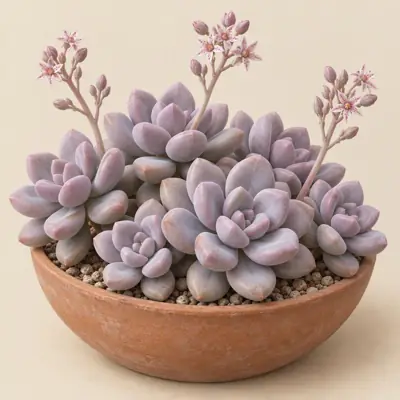
Overview
Graptopetalum amethystinum is a perennial succulent that grows in clusters of rosettes.
Origin and habitat
It is native to Mexico, with one source specifying Jalisco; sources differ in how precisely they describe its native range. It is reported to occur in high-elevation mountain habitats in Mexico.
Characteristics
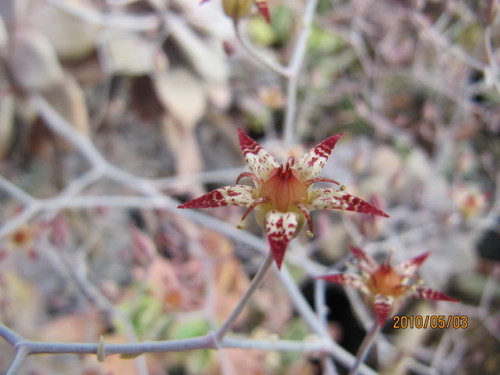
A single source reports a mature height of about 10–50 cm and a mature spread of about 10–50 cm, so sources are few for these measurements. The fleshy, hairless, obovate and very plump leaves form rosettes at the stem tips; their color may vary seasonally among gray, violet and pale green, while another description gives pink to green leaves with a pale powdery coating. The star-shaped flowers are upright or borne in branched inflorescences, with petals that are white to pale yellow at the base and marked with red toward the tips or with large red patches; flowering is reported in spring. Graptopetalum amethystinum stores water in its leaves.
Light
It takes full sun, although sources differ on light management, with some recommending some shade during hot, stuffy summer conditions and emphasizing good ventilation.
Watering
Sources differ on watering: guidance includes watering thoroughly after the growing medium dries while avoiding standing water and reducing watering in summer, autumn and winter, whereas another source recommends ample water during spring and summer growth and keeping the medium only slightly moist in autumn and winter.
Humidity and airflow
It is reported to need good airflow.
Temperature and dormancy
Sources differ on minimum temperature information, with one limited account giving about -2 °C and another limited account giving about -3 °C. It is reported as RHS H2 and is reported to tolerate brief light frost. It is reported to be susceptible to hot, stuffy summer conditions, when reduced watering and shade are recommended.
Growing medium and mounting
A well-drained loam or sandy growing medium is suitable, and containers can use a well-drained, peat-free loam-based medium; it needs a fast-draining mix.
Feeding
Fertilizer may be applied during growth; sources describe diluted low-nitrogen liquid fertilizer in spring and summer or slow-release or liquid fertilizer in spring and autumn.
Propagation
It can be propagated from seed, stem cuttings, leaf cuttings or division, and leaf propagation is described as easy for this species.
Common problems
Scale insects may occur, although another source describes the species as generally having few pest problems. Soft rot may occur, with excessive moisture and hot, humid, poorly ventilated conditions increasing the risk, although another source describes the species as generally having few disease problems. Key cultivation risks include standing water, prolonged rain, and hot, stuffy summer conditions. Cold tolerance is limited, and cold winds, frost, and freezing of the leaves should be avoided; hot, stuffy conditions and prolonged rain are also concerns in summer.
Identification
It is reported to be distinguished by very plump fleshy leaves, rosettes at the stem tips, leaf colors that can shift among gray, purple and pale green, and conspicuous red markings at the petal tips.
Photos


Sources
- Wikipedia (en): Graptopetalum amethystinum — CC BY-SA 4.0 · link
- Wikipedia (es): Graptopetalum amethystinum — CC BY-SA 4.0 · link
- Wikipedia (it): Graptopetalum amethystinum — CC BY-SA 4.0 · link
- RHS Plants: Graptopetalum amethystinum — © RHS, facts only · link
- The Succulent Plant Page: Graptopetalum (genus-level) — © R.J. Hodgkiss, facts only · link
- NHK みんなの趣味の園芸 植物図鑑: Graptopetalum amethystinum — © NHK出版, facts only · link
- PUKUBOOK: Graptopetalum amethystinum — CC BY-NC (facts only) · link
- Graptopetalum amethystinum | Giromagi cactus and succulents for sale | Buy plant (www.giromagi.com) — facts only (§12) · link