
Guzmania (Guzmania hybrid)
Guzmania is reported to consist mostly of evergreen, upright, stemless or inconspicuously stemmed epiphytic herbs whose leaves form a rosette with a water-holding central tank. It is reported to be perennial; after a mother plant flowers, it gradually dies while basal offsets continue the growth.
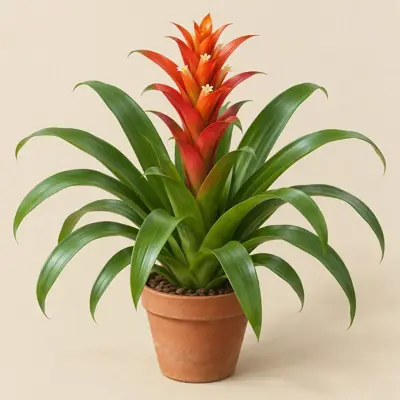
Overview
Guzmania is reported to consist mostly of evergreen, upright, stemless or inconspicuously stemmed epiphytic herbs whose leaves form a rosette with a water-holding central tank. It is reported to be perennial; after a mother plant flowers, it gradually dies while basal offsets continue the growth.
Origin and habitat
Guzmania is native to tropical America, but sources differ on the more specific extent of its range, variously including Brazil, southern Mexico, Central America, northern and western South America, Florida, and the Caribbean. It is reported to be primarily epiphytic in humid, shaded tropical rainforest, growing on trees and other supports, including high-elevation Andean rainforest. It is reported to be adapted mainly to warm, humid tropical environments, while its natural range also includes cooler high-elevation rainforest.
Characteristics
Few-source estimates place mature height at about 20–91 cm and mature spread at about 61–61 cm. The leaves are reported to be strap-shaped and arranged in an overlapping rosette that forms a water-holding central tank; their margins are entire and spineless, and the foliage may be green or variegated. The inflorescence is reported to emerge from the center of the rosette, with usually small true flowers surrounded by conspicuous, long-lasting bracts that may be red, yellow, orange, or pink. Sources differ on when flowering begins; growth is reported to be slow, and the fruit is reported to be a capsule.
Light
For most indoor cultivation, Guzmania is reported to suit bright indirect light or filtered light; it may be kept in partial shade during its warmer growing period and given more sunlight in the cooler period, while light tolerance varies among species from sun to shade. Bright indirect light is generally suitable.
Watering
It is generally watered from above to fill the central tank, with the water replaced regularly; under cool winter conditions, water in the tank is reduced or removed and the growing medium may be kept drier.
Humidity and airflow
Guzmania generally prefers high humidity.
Temperature and dormancy
Sources differ on the reported hardiness-zone rating for Guzmania. It is generally frost tender; keep above freezing.
Growing medium and mounting
The growing medium is reported to need good drainage and may consist of sphagnum moss, coconut husk, orchid bark medium, or an indoor-plant medium amended with bark and perlite; epiphytic culture may also omit ordinary soil. Guzmania can generally be mounted, grown in a basket or potted.
Feeding
During the growing period from spring through autumn, slow-release chemical fertilizer may be applied periodically; another source recommends regularly applying diluted liquid fertilizer into the leaf tank during growth.
Propagation
Guzmania is propagated by separating basal offsets that form after flowering; sources differ on the recommended stage for separation, using leaf development, size relative to the mother plant, rosette development, and root development as criteria.
Common problems
Reported pests include scale insects and spider mites, while water held in the leaf tank outdoors may also provide a mosquito breeding site. Reported diseases include anthracnose and root rot, with excessively wet roots combined with low temperatures associated with potentially fatal root rot, including root rot caused by pathogens such as Cochliobolus sativus. Cold, overly wet conditions are reported to cause root rot, while the mother plant's gradual death after flowering is a natural process and should not be confused with general decline. Guzmania is reported to have low cold tolerance and strong heat tolerance, preferring warm conditions and relatively high air humidity.
Identification
Guzmania is reported to be distinguished by spineless, entire, strap-shaped leaves forming a water-holding rosette, with a torch-like central inflorescence and bright, long-lasting bracts.
Sources
- Wikipedia (en): Guzmania — CC BY-SA 4.0 · link
- NHK みんなの趣味の園芸 植物図鑑: Guzmania (genus-level) — © NHK出版, facts only · link
- NC State Plant Toolbox: Guzmania (genus-level) — copyright (facts only) · link
- How to Grow a Gorgeous Guzmania Bromeliad - Garden Betty (gardenbetty.com) — facts only (§12) · link
- Guzmania Houseplant Care And Growing Guide | Gardening Know How (www.gardeningknowhow.com) — facts only (§12) · link
- Guzmania über Kindel vermehren » Wissenswertes zu Tochterpflanzen (www.gartenjournal.net) — facts only (§12) · link