
droophead tufted airplant (Guzmania lingulata)
Guzmania lingulata is a stemless, clumping evergreen epiphytic herb whose leaves form a basal rosette. It is perennial; after flowering, a rosette gradually declines and dies while producing offsets.
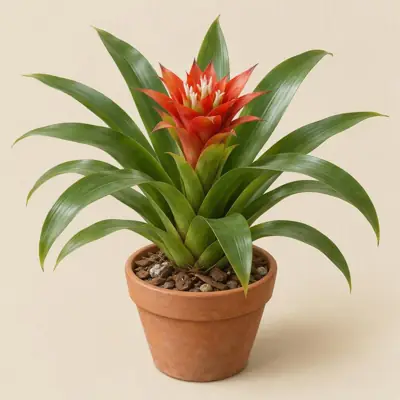
Overview
Guzmania lingulata is a stemless, clumping evergreen epiphytic herb whose leaves form a basal rosette. It is perennial; after flowering, a rosette gradually declines and dies while producing offsets.
Origin and habitat
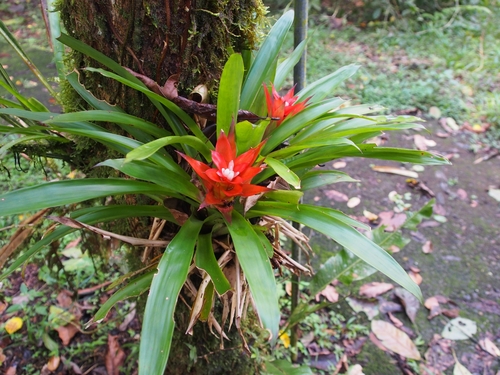
Sources differ on the documented native range, which is described across tropical America, including Central America, northern and central South America, southern Mexico and the West Indies, with some accounts also specifically recording Peru, Bolivia, Puerto Rico and the U.S. Virgin Islands as native areas. It is an epiphyte of tropical rainforest and occurs in very wet forest, cloud forest and evergreen forest; sources differ on its documented elevational distribution. Its habitat has a tropical, humid forest climate.
Characteristics
Sources differ and are few on mature height, reported at about 10–50 cm; a single source reports a mature spread of about 10–50 cm. Green, tongue-shaped leaves with pointed tips form a star-shaped basal rosette; their surfaces range from hairless to sparsely scaly, their margins lack spines, and overlapping leaf bases form a central water-holding tank. The dense inflorescence bears conspicuous red or orange bracts and small white flowers, while cultivated forms can also show burgundy, yellow or pink coloration; flowering has been recorded from July into February, and genus-level horticultural information also describes summer flowering. A single source reports capsule fruits with seeds bearing rust-colored tufts, and reports fruit as visible through most of the year in native habitat.
Light
Guzmania lingulata does best in bright indirect light to partial shade, can tolerate shadier conditions and artificial lighting, and should be protected from strong direct summer sun.
Watering
During growth, fill the central tank and keep the root medium only slightly moist, avoiding overwatering; staying moist is fine, and old water in the tank should be replaced periodically. In colder winter conditions, reduce moisture or drain standing water from the central tank.
Humidity and airflow
It is generally reported to prefer high humidity and to need moderate airflow.
Temperature and dormancy
Few sources report an ideal temperature of about 18–27 °C and a minimum of about 16 °C. It is generally reported to be frost tender and should be kept above freezing; a USDA hardiness classification is also reported.
Growing medium and mounting
Use a bromeliad or orchid medium with good aeration and drainage; sources also suggest sphagnum or coconut-husk media, while the RHS lists loamy or sandy conditions that are moist but well drained. It is generally reported that Guzmania lingulata can be mounted, grown in a basket or potted.
Feeding
Fertilizer can be applied periodically during growth, but sources differ in the recommended schedule, with one describing slow-release chemical fertilizer from spring through autumn and another describing diluted houseplant fertilizer throughout the year.
Propagation
Propagation can be by seed or by separating basal offsets formed after flowering; sources recommend separating offsets after sufficient development, and the RHS recommends division in mid-spring.
Common problems
Scale insects, spider mites and mealybugs may occur. Sources differ on disease occurrence: leaf spot may occur and cultivation information also records anthracnose, while the RHS describes disease as generally uncommon. Strong direct sunlight can cause sunscald, the mother plant naturally declines after flowering, and cultivation research indicates that excessive boron concentrations or sodium chloride can cause leaf-tip necrosis, leaf curling and reduced growth. It has weak cold tolerance, prefers warm conditions and should be protected from strong direct summer sun; the RHS classifies it as suited to protected conditions.
Identification
Guzmania lingulata can be recognized by its star-shaped basal rosette, conspicuous red to orange bracted inflorescence at the center, tongue-shaped leaves with spineless margins, and a central water-holding tank formed by the rosette.
Photos



Sources
- Wikipedia (en): Guzmania lingulata — CC BY-SA 4.0 · link
- Wikipedia (fr): Guzmania lingulata — CC BY-SA 4.0 · link
- Wikipedia (es): Guzmania lingulata — CC BY-SA 4.0 · link
- GBIF descriptions: Lista de chequeo de las plantas nativas de la cuenca del río Claro (Antioquia, Colombia) con reporte — per dataset · link
- NC State Plant Toolbox: Guzmania lingulata — copyright (facts only) · link
- RHS Plants: Guzmania lingulata — © RHS, facts only · link
- USDA PLANTS Database: Guzmania lingulata — Public domain (US Government work) · link
- NHK みんなの趣味の園芸 植物図鑑: Guzmania (genus-level) — © NHK出版, facts only · link
- Bromeliad Plant Growing Specifications - Guzmania Lingulata And Hybrids | Bromel (bromeliads.info) — facts only (§12) · link
- Guzmania & Bromelia (www.ukhouseplants.com) — facts only (§12) · link
- Guzmania Houseplant Care And Growing Guide | Gardening Know How (www.gardeningknowhow.com) — facts only (§12) · link
- How to Plant, Grow, and Care for Guzmania (www.epicgardening.com) — facts only (§12) · link
- Guzmania Bromeliad Care & Growing Guide (2026 ) (www.joyusgarden.com) — facts only (§12) · link
- Guzmania (Bromeliad) | North Carolina Extension Gardener Plant Toolbox (plants.ces.ncsu.edu) — facts only (§12) · link