
Gymnocalycium baldianum (Gymnocalycium baldianum)
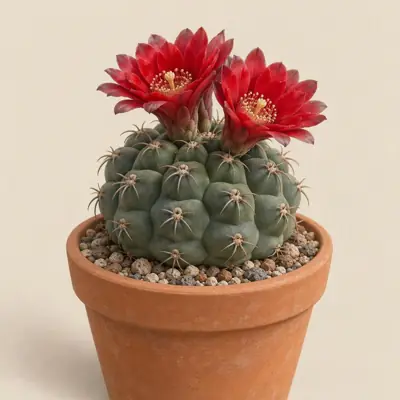
Gymnocalycium baldianum is a small, globular cactus with a flattened-globular to globular stem; young plants are usually solitary, while older plants may produce basal offsets and form clumps. It is reported to be an evergreen perennial cactus.
Overview
Gymnocalycium baldianum is a small, globular cactus with a flattened-globular to globular stem; young plants are usually solitary, while older plants may produce basal offsets and form clumps. It is reported to be an evergreen perennial cactus.
Origin and habitat
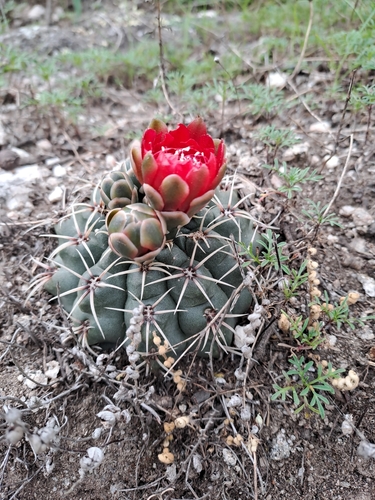
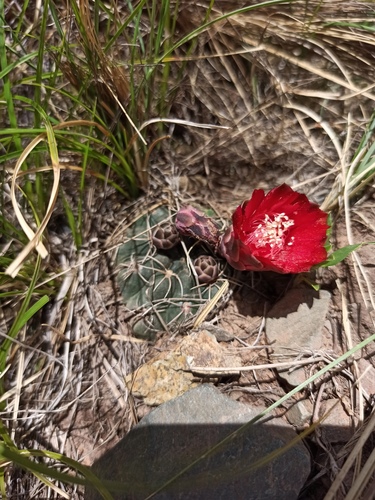
It is native to Catamarca Province in northwestern Argentina, where multiple sources record it from local mountain areas including Sierra de Ancasti, Sierra Graciana, Sierra de Narváez, Sierra de Guayamba, Sierra de Manchao, and mountains east of Andalgalá. It occurs in dry mountainous to high-elevation environments, including desert, dry scrub, and among herbaceous vegetation; sources differ on its recorded elevation range.
Characteristics
Mature plants reach 4–10 cm in height, while sources differ on spread, placing it at about 6–10 cm. Growth is relatively fast, and seed-grown plants can flower comparatively soon after sowing. Sources differ somewhat in their descriptions of the funnel-shaped flowers near the top of the plant: deep pink, red, and purplish red are common, with pink, orange, or white variants also recorded; flowering is mainly from spring and summer into autumn, with the period varying among growing locations and sources. The fruit is spindle-shaped to elongated, becoming dark gray-green to green when mature and capable of splitting lengthwise.
Light
Gymnocalycium baldianum takes full sun and also suits bright partial shade; intense direct summer sun can cause sunburn, while bright filtered light can be used in greenhouse cultivation.
Watering
Water moderately to generously during the growing season, allowing the medium to dry before watering again; keep it dry or nearly dry in winter.
Humidity and airflow
It is generally reported to need good airflow.
Temperature and dormancy
It is frost hardy, with a stated cold minimum of -10 °C. Sources differ in their hardiness classifications. It rests cool and dry in winter.
Growing medium and mounting
It needs a fast-draining cactus mix; loamy or sandy media are listed, and the medium may be acidic, neutral, or alkaline.
Feeding
Feed during the growing season; sources differ in recommending cactus fertilizer, balanced liquid fertilizer, or a high-potassium fertilizer in summer.
Propagation
Propagation is mainly by seed, while offsets can also be used as cuttings and grafting is also recorded. Seed can be sown in early spring.
Common problems
Mealybugs are reported as a possible pest, while one source reports no significant disease problems in general. Intense direct summer sun is reported to be capable of scorching the plant body. Cold tolerance is closely related to dryness; sources report greater cold tolerance when dry, although some also advise avoiding frost.
Identification
Sources describe the stem as flattened-globular and gray-green to blue-green, with tuberculate divisions on the ribs, no central spines, slender gray or brown radial spines held close to the stem, and brightly colored funnel-shaped flowers at the top.
Photos


Sources
- Wikipedia (en): Gymnocalycium baldianum — CC BY-SA 4.0 · link
- 維基百科:緋花玉 — CC BY-SA 4.0 · link
- Wikipedia (de): Gymnocalycium baldianum — CC BY-SA 4.0 · link
- Wikipedia (fr): Gymnocalycium baldianum — CC BY-SA 4.0 · link
- Wikipedia (es): Gymnocalycium baldianum — CC BY-SA 4.0 · link
- LLIFLE Encyclopedia of living forms: Gymnocalycium baldianum — CC BY-SA · link
- RHS Plants: Gymnocalycium baldianum — © RHS, facts only · link
- Desert-Tropicals: Gymnocalycium baldianum — © Philippe Faucon (desert-tropicals.com), facts only · link
- The Succulent Plant Page: Gymnocalycium (genus-level) — © R.J. Hodgkiss, facts only · link
- PUKUBOOK: Gymnocalycium baldianum — CC BY-NC (facts only) · link