
moon cactus (Gymnocalycium mihanovichii)
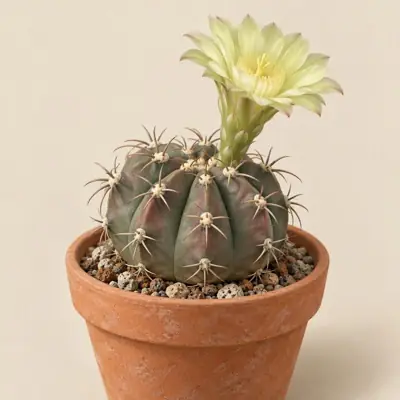
Gymnocalycium mihanovichii is a small, globular cactus that may grow singly or produce offsets; the typical form has a broadly globular stem.
Overview
Gymnocalycium mihanovichii is a small, globular cactus that may grow singly or produce offsets; the typical form has a broadly globular stem.
Origin and habitat
It is native to South America, certainly including Paraguay, while sources differ on accounts that also include northeastern Argentina. It occurs at low elevations in rocky places and in shaded sites beneath shrubs. Its growing season is relatively warm, and it is adapted to drier, well-drained conditions, with drier conditions in winter.
Characteristics
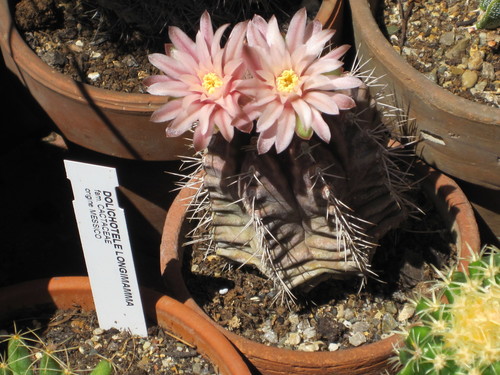
Sources differ, but mature height is reported at about 3–5 cm and spread at about 3–6 cm. Sources differ on growth rate, describing it from slow-growing to relatively fast-growing. Flowers arise near the top of the plant and are bell-shaped to funnel-shaped; in the typical form they are mainly yellow-green, pale olive-green, or brownish yellow, with flowering from late spring to early summer. The fruit is spindle-shaped; another account describes it as a small, fleshy, gray-green, berry-like fruit that turns red when mature.
Light
Bright indirect or filtered light is suitable, and the plant tolerates bright light or part shade, including some direct sun, although excessive exposure during hot periods may cause sunburn or suppress growth.
Watering
During the growing season, allow the growing medium to dry after watering before watering again and avoid waterlogging; greatly reduce watering during winter dormancy, with some sources recommending keeping it dry.
Humidity and airflow
It is reported to prefer low humidity.
Temperature and dormancy
Specialist-supported sources give a cold minimum of 0 °C, while other sources differ on minimum-temperature guidance. A limited source reports an upper temperature of about 30 °C. A specialist source reports a USDA hardiness-zone classification without a consistently renderable numeric range and generally describes the plant as tolerating brief light frost. It rests cool and dry in winter.
Growing medium and mounting
Use a well-drained, porous cactus or succulent growing medium; it prefers a low pH and substrates rich in lime should be avoided. A specialist source reports that it needs a very fast-draining mix.
Feeding
Fertilize only during the growing season; one source recommends a high-potassium fertilizer in summer.
Propagation
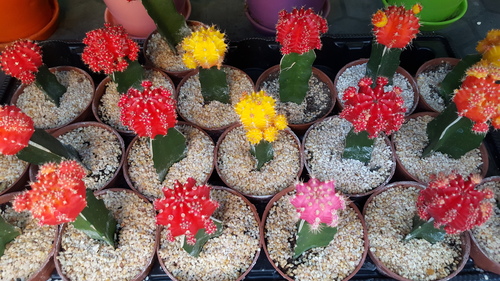
Sources describe propagation by seed, offsets, or grafting; chlorophyll-free colored mutants require grafting onto another cactus rootstock to maintain growth.
Common problems
A specialist source reports possible infestations by spider mites and mealybugs, while pests are generally less common with good airflow and suitable growing-medium conditions. Overwatering or high humidity may lead to fungal disease and rot. Overwatering readily causes rot, while strong direct summer sun may cause sunburn or suppress growth; grafted moon cacti may also become unstable or separate after several years because the scion and rootstock differ in growth rate and eventual size. Frost or freezing should be avoided, and strong direct sun in hot weather may cause sunburn; a container-growing source recommends moving outdoor plants indoors when temperatures become sufficiently low.
Identification
The stem is broadly globular to globular, and the typical form is usually gray-green to dark green and may have red coloration; it has narrow, notched ribs with transverse grooves and short, slightly curved spines at the areoles. Chlorophyll-free horticultural mutants may be red, orange, pink, yellow, purple, or white and usually require grafting to remain viable.
Photos


Sources
- Wikipedia (en): Gymnocalycium mihanovichii — CC BY-SA 4.0 · link
- Wikipedia (ja): ヒボタン — CC BY-SA 4.0 · link
- Wikipedia (de): Gymnocalycium mihanovichii — CC BY-SA 4.0 · link
- Wikipedia (es): Gymnocalycium mihanovichii — CC BY-SA 4.0 · link
- NC State Plant Toolbox: Gymnocalycium mihanovichii — copyright (facts only) · link
- LLIFLE Encyclopedia of living forms: Gymnocalycium mihanovichii — CC BY-SA · link
- The Succulent Plant Page: Gymnocalycium (genus-level) — © R.J. Hodgkiss, facts only · link
- Gymnocalycium mihanovichii | Giromagi cactus and succulents for sale | Buy plant (www.giromagi.com) — facts only (§12) · link
- PUKUBOOK: Gymnocalycium mihanovichii — CC BY-NC (facts only) · link