
moon cactus (Gymnocalycium mihanovichii)
Gymnocalycium mihanovichii is a small, globular cactus; 'Hibotan' is commonly grown as a colorful scion grafted onto green rootstock and may also form clusters from the base.
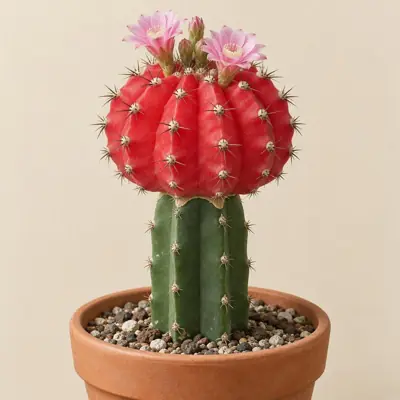
Overview
Gymnocalycium mihanovichii is a small, globular cactus; 'Hibotan' is commonly grown as a colorful scion grafted onto green rootstock and may also form clusters from the base.
Origin and habitat
Paraguay is consistently recorded within the species' native range, while sources differ on its northern distribution and variously also record northeastern Argentina or northeastern Bolivia; the cultivated Hibotan group is recorded as having been developed in Japan. The species occurs at low elevations in rocky settings and beneath shrubs, where it receives direct sunlight during only part of the year. It is reported to grow in summer and to suit cultivation with low humidity, good airflow, and good drainage.
Characteristics
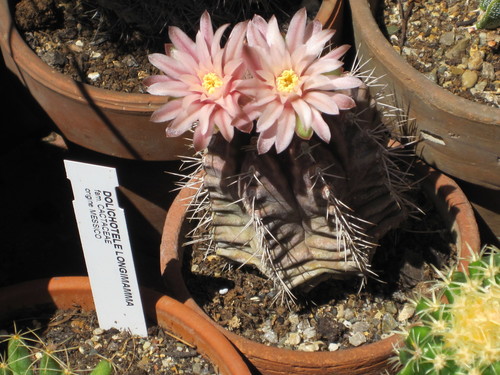
Sources differ, but the limited information suggests a mature height of about 3–5 cm and a mature spread of about 3–6 cm. Sources describe the growth rate differently, ranging from slow to relatively fast, while grafted plants sold horticulturally are described as slow-growing. Flowers are borne near the top and are bell- to funnel-shaped; species accounts mostly describe pale green, yellow-green, olive-green, or brownish-yellow flowers, while Japanese information on Hibotan records pink or white flowers in the cultivated group. Flowering is recorded from spring through summer, and the fruit is spindle-shaped; another source describes it as small, fleshy, gray-green, and berry-like, becoming red when ripe.
Light
Bright indirect or filtered light is suitable, and the plant tolerates bright light or part shade and some direct light, but excessive exposure during the hottest part of summer may cause sunburn or inhibit growth.
Watering
During the growing season, allow the growing medium to dry thoroughly after watering before watering again, and avoid waterlogging; water can be supplied more frequently in summer, while during winter dormancy watering should be greatly reduced or the plant kept dry.
Humidity and airflow
The plant is generally reported to prefer low humidity and to need good airflow.
Temperature and dormancy
Sources differ, but limited information places the minimum at about 10 °C, while another limited source reports a maximum of about 30 °C. Sources differ on hardiness, and the available account places it in a warm hardiness zone. Specialist information records a cold minimum of 0 °C and generally reports that it tolerates brief light frost and rests cool and dry in winter, while another source describes it as not frost tolerant.
Growing medium and mounting
Use a well-drained cactus or succulent medium; information for the species also recommends a highly porous, relatively low-pH medium that is not rich in lime. It needs a fast-draining mix.
Feeding
Fertilize only during the growing season; one specialist source recommends a high-potassium fertilizer in summer.
Propagation
Gymnocalycium can produce offsets, but because Hibotan lacks chlorophyll, its offsets generally need to be grafted again onto new rootstock; the species is also recorded as being propagated by seed and grafting. Seed is a recorded propagation method.
Common problems
Rot is a principal concern, and problems are generally fewer when drainage, watering, and airflow are appropriate. Overwatering is reported to readily cause rot, while strong direct light, especially in hot summer conditions, may cause sunburn or suppress growth. In grafted Hibotan, differences in growth rate and size between rootstock and scion may eventually cause the graft union to separate, requiring regrafting. Grafted ornamental plants do not tolerate severe frost and should be moved indoors in cold conditions; strong direct sunlight in hot conditions may also cause sunburn.
Identification
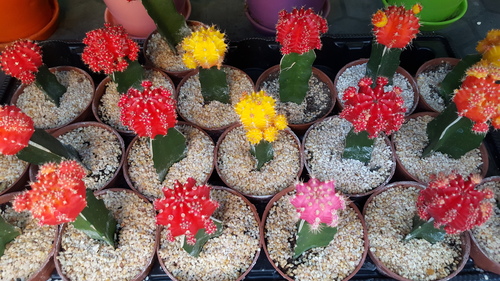
'Hibotan' is a colorful form lacking some or all chlorophyll and may be red, orange, deep purple, yellow, white, or pink, with prominent ribs, transverse grooves, and short spines. Individuals completely lacking chlorophyll must be grafted onto chlorophyll-bearing rootstock to obtain nutrients.
Photos


Sources
- Wikipedia (en): Gymnocalycium mihanovichii — CC BY-SA 4.0 · link
- Wikipedia (ja): ヒボタン — CC BY-SA 4.0 · link
- Wikipedia (de): Gymnocalycium mihanovichii — CC BY-SA 4.0 · link
- Wikipedia (es): Gymnocalycium mihanovichii — CC BY-SA 4.0 · link
- NC State Plant Toolbox: Gymnocalycium mihanovichii — copyright (facts only) · link
- LLIFLE Encyclopedia of living forms: Gymnocalycium mihanovichii — CC BY-SA · link
- The Succulent Plant Page: Gymnocalycium (genus-level) — © R.J. Hodgkiss, facts only · link
- PUKUBOOK: Gymnocalycium mihanovichii — CC BY-NC (facts only) · link
- Gymnocalycium mihanovichii - Pink Grafted Moon Cactus | MCG™ (mountaincrestgardens.com) — facts only (§12) · link
- Gymnocalycium mihanovichii cv. Hibotan | Giromagi cactus and succulents for sale (www.giromagi.com) — facts only (§12) · link