
Haworthiopsis attenuata (Haworthiopsis attenuata)
Haworthiopsis attenuata is an evergreen perennial succulent with a low, nearly stemless rosette habit that readily produces offsets and forms clumps or mat-like colonies.
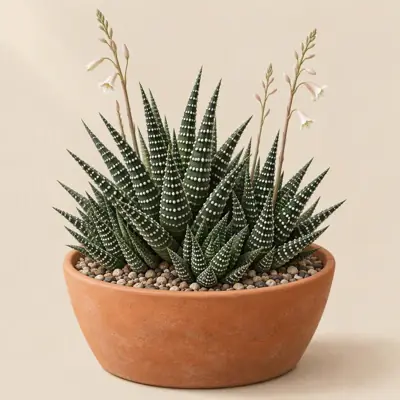
Overview
Haworthiopsis attenuata is an evergreen perennial succulent with a low, nearly stemless rosette habit that readily produces offsets and forms clumps or mat-like colonies.
Origin and habitat
Sources differ on its native range, describing it as occurring in South Africa's Eastern Cape, including the area from Hankey to Fish River. It occurs in dry scrub, often growing beneath shrubs to avoid intense sunlight, and wild plants may be partly buried in sand. Its native environment is reported to be dry with intense sunlight and to include Bushveld and dry Karroid scrub habitats.
Characteristics
Sources differ, with the few available reports placing mature height at about 6–25 cm and spread at about 15.24–60.96 cm. It is reported to grow slowly and has fleshy, rigid, dark green leaves that are narrow to narrowly triangular, taper to a point, store water in their leaves, and bear raised white tubercles often arranged in transverse bands on both surfaces. Sources differ in describing the small, tubular flowers, which are borne on slender flower stalks and are mainly white to pale greenish white. Sources differ, but native seasonal data place flowering in spring.
Light
Bright light or part shade is suitable, including bright indirect light; some direct sunlight is tolerated, but sources differ and hot, intense light may scorch leaves or cause them to turn white or yellow.
Watering
During the growing period, allow the growing medium to dry progressively after watering and avoid keeping it persistently wet; greatly reduce watering in winter and water again after the medium has dried. In winter, watering is specified at 14 days.
Humidity and airflow
It is generally reported to prefer low humidity and need good airflow.
Temperature and dormancy
Sources are few and differ, but the reported lower temperature threshold is about 10 °C. Hardiness is classified under both USDA and RHS systems, and the plant is frost tender; keep above freezing. Too much direct sunlight can make the leaves turn white or yellow, and protection from hot sunlight is needed.
Growing medium and mounting
Use a loose, porous cactus or succulent medium with good drainage; a sandy medium can be used, and waterlogging should be avoided. It needs a fast-draining mix.
Feeding
Feed lightly during the growing period; diluted fertilizer or a low-nitrogen fertilizer is recommended.
Propagation
It can be propagated by separating offsets, by leaf cuttings in spring or summer, or by sowing seed in spring.
Common problems
Scale insects and mealybugs may occur. Persistently wet growing medium is reported to be associated with root rot, while overly wet soil or prolonged water on the leaves may be associated with leaf spots and fungal diseases. Overwatering may cause root rot, insufficient light may fade the leaf markings, and excessively strong direct sunlight may scorch leaves or make them turn white or yellow. It is frost tender and should be protected from cold drafts; although it may briefly tolerate low temperatures, hot and excessively strong direct sunlight should also be avoided.
Identification
Haworthiopsis attenuata has dark green leaves with conspicuous raised white tubercles and transverse bands; compared with the similar Haworthiopsis fasciata, its leaves may have tubercles on both upper and lower surfaces, while H. fasciata has a smoother upper surface, and its leaves are also described as non-fibrous.
Photos


Sources
- Wikipedia (en): Haworthiopsis attenuata — CC BY-SA 4.0 · link
- NC State Plant Toolbox: Haworthiopsis attenuata — copyright (facts only) · link
- LLIFLE Encyclopedia of living forms: Haworthiopsis attenuata — CC BY-SA · link
- RHS Plants: Haworthiopsis attenuata — © RHS, facts only · link
- PUKUBOOK: Haworthiopsis attenuata — CC BY-NC (facts only) · link