
Common Ivy (Hedera helix)
Hedera helix is a perennial evergreen, woody climbing vine that can also creep along the ground as ground cover, using aerial roots on its stems to attach to supports such as tree trunks and walls.
Overview
Hedera helix is a perennial evergreen, woody climbing vine that can also creep along the ground as ground cover, using aerial roots on its stems to attach to supports such as tree trunks and walls.
Origin and habitat
Sources differ on its native range, describing it as primarily native to Europe and extending into western Asia, including Turkey and Iran. It occurs in woodland, hedges, and shaded places, where it can climb trees, walls, and rock faces or creep along the ground. It is mainly adapted to temperate environments of the Northern Hemisphere, is cold-hardy, and can adapt to climates similar to those of its native European range.
Characteristics
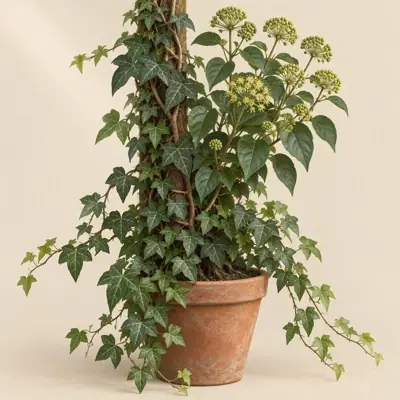
Sources differ on mature height, with estimates of about 800–3000 cm, while a single source reports a mature spread of about 250–400 cm. Sources differ in describing its growth rate as moderate to fast; it can extend vigorously when planted in the ground or given suitable support. The alternate leaves are leathery to thick; juvenile vegetative shoots usually have palmately lobed leaves, while mature flowering shoots bear unlobed, heart-shaped to diamond-shaped leaves. The small greenish-yellow, nectar-rich flowers are grouped in rounded umbels from late summer into autumn, sometimes continuing into late autumn; the berries mature from winter to late winter, ranging in mature color from orange-yellow to purple-black or black, and may be eaten by birds that help disperse the seeds.
Light
Hedera helix can adapt from full sun through partial shade to full shade but generally prefers a shaded position, and very deep shade may inhibit flowering.
Watering
It does best in moist but well-drained to generally well-drained soil, dislikes prolonged waterlogging and extreme dryness, and has some drought tolerance once established.
Temperature and dormancy
A single source reports a minimum temperature of about -25 °C; sources are few.
Growing medium and mounting
It adapts to a broad range of soils, including clay, loam, sand, and calcareous soils, with good drainage preferred; it can grow in acidic, neutral, and alkaline soils, although one source indicates that it dislikes very acidic soil.
Propagation
A single source reports that Hedera helix can be propagated by cuttings, cuttings rooted in water, or layering, with propagation generally easier in spring or autumn.
Common problems
A single source lists aphids, mealybugs, caterpillars, armored scale insects, soft scale insects, and two-spotted spider mites as common pests. Vigorous growth may spread beyond intended areas; attachment roots can leave marks on walls, and unmanaged vines may enter gutters or roof spaces or lift tiles. In some regions outside its native range, it may escape cultivation, become naturalized, or be listed as invasive. It is generally cold-hardy and has some drought tolerance once established, but dislikes extreme dryness or waterlogging; variegated cultivars may be less cold-hardy than the species.
Identification
Hedera helix shows pronounced leaf heteromorphy: creeping or climbing juvenile shoots usually have lobed leaves, while mature fertile flowering shoots have unlobed leaves, and climbing stems attach firmly to substrates with aerial roots.
Photos


Sources
- Wikipedia (en): Hedera helix — CC BY-SA 4.0 · link
- 維基百科:常春藤 — CC BY-SA 4.0 · link
- Wikipedia (ja): セイヨウキヅタ — CC BY-SA 4.0 · link
- Wikipedia (de): Gemeiner Efeu — CC BY-SA 4.0 · link
- Wikipedia (fr): Lierre grimpant — CC BY-SA 4.0 · link
- Wikipedia (es): Hedera helix — CC BY-SA 4.0 · link
- GBIF descriptions: Database of Vascular Plants of Canada (VASCAN); Lista de especies de plantas exóticas y trasplantada — per dataset · link
- Useful Tropical/Temperate Plants: Hedera helix — CC BY-NC-SA 3.0 (facts only) · link
- RHS Plants: Hedera helix — © RHS, facts only · link
- USDA PLANTS Database: Hedera helix — Public domain (US Government work) · link