
Hawaiian-elf (Heptapleurum arboricola)
Heptapleurum arboricola is an evergreen woody perennial that grows as a shrub to small tree; it may grow independently or as an epiphyte attached to other tree trunks, and it is commonly grown as an indoor potted plant.
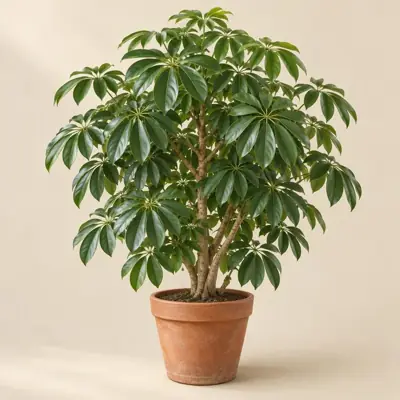
Overview
Heptapleurum arboricola is an evergreen woody perennial that grows as a shrub to small tree; it may grow independently or as an epiphyte attached to other tree trunks, and it is commonly grown as an indoor potted plant.
Origin and habitat
Sources differ in describing its native range: records include Taiwan and Hainan in China, while broader horticultural sources describe it as native to China and Taiwan. It is a tropical plant suited to warm environments without severe frost or where it can be protected.
Characteristics
Sources differ, with limited evidence placing mature height at about 91.44–182.88 cm and mature spread at about 121.92–182.88 cm. The leaves are palmately compound, with glossy, leathery leaflets ranging in shape from obovate to oblong or elliptic; young plants have smaller leaves with fewer leaflets. Sources differ in describing the small, radially symmetrical flowers, which are borne in compound panicles and are mainly reported as yellow to green; flowering occurs from midsummer to early autumn but is rare indoors. Sources differ in describing the small, nearly spherical to ovoid drupes, which may initially be orange and become darker when mature.
Light
It grows in bright indirect light to partial shade and is suited to filtered light indoors; it can adapt to varied light levels, but strong direct light may scorch the leaves.
Watering
Water thoroughly after the growing medium has dried to some degree, provide moderate water during active growth, and reduce watering in winter; avoid prolonged waterlogging to reduce the risk of root rot.
Humidity and airflow
It is reported to prefer high humidity.
Temperature and dormancy
Limited evidence reports a minimum temperature of about 15.6 °C. An RHS hardiness classification is reported for the plant.
Growing medium and mounting
Use a well-drained potting medium rich in organic matter; loamy or sandy soil is suitable, across acidic, neutral, or alkaline conditions, and the medium should remain moist without becoming waterlogged.
Feeding
A balanced liquid fertilizer is generally applied regularly during the growing period.
Propagation
It can be propagated by seed, semi-ripe cuttings, or air layering, and stem cuttings can root in soil or water.
Common problems
Possible pests include spider mites, scale insects, mealybugs, and thrips. Serious disease problems are generally not prominent, but persistently wet growing medium or waterlogging can cause root rot. Both overly wet and overly dry potting soil can cause leaf drop, while strong direct indoor light may scorch the leaves. It does not tolerate severe frost and requires a warm, protected environment.
Identification
Palmately compound leaves on long petioles typically consist of several glossy leaflets, and aerial roots may form under suitable conditions.
Sources
- Wikipedia (en): Heptapleurum arboricola — CC BY-SA 4.0 · link
- GBIF descriptions: Especies introducidas, exóticas, trasplantadas, invasoras y potencialmente invasoras obtenidas a par — per dataset · link
- NC State Plant Toolbox: Heptapleurum arboricola — copyright (facts only) · link
- TaiCOL 臺灣物種名錄: Heptapleurum arboricola — CC BY 4.0 · link
- RHS Plants: Heptapleurum arboricola — © RHS, facts only · link