
China-rose (Hibiscus rosa-sinensis)
Hibiscus rosa-sinensis is a perennial plant. Sources differ in describing its habit; it is described as an evergreen, much-branched woody shrub to small tree.
Overview
Hibiscus rosa-sinensis is a perennial plant. Sources differ in describing its habit; it is described as an evergreen, much-branched woody shrub to small tree.
Origin and habitat
Its true native range is disputed; more recent information treats it as a cultivated hybrid of horticultural origin with no confirmed truly wild populations, with its parents associated with Vanuatu and French Polynesia. No truly wild habitat has been confirmed; it has long been cultivated and is widely grown in tropical and subtropical regions. It is a tropical to subtropical plant that can also be cultivated in warmer temperate regions and does not tolerate severe cold.
Characteristics
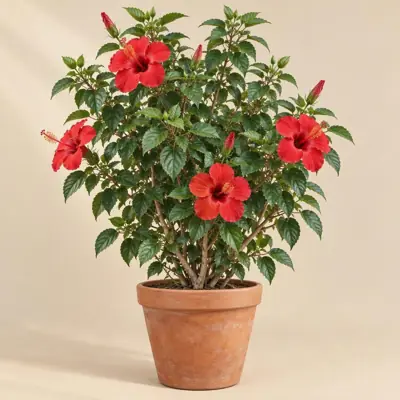
Sources differ, but the mature height is reported at about 250–500 cm; few sources are available for mature spread, which is reported at about 150–300 cm. Growth is generally moderate, and the simple, stalked, alternate leaves are ovate with pointed tips, serrated margins, glossy surfaces, netted veins, and stipules. Flowers are usually solitary; the typical form has red petals, while cultivars may be white, pink, orange, peach, yellow, blue, or purple and may have double flowers, and a prominent staminal column projects beyond the corolla. Sources differ on flowering time: flowering occurs chiefly in spring, summer, and autumn, while under suitable cultivation the plant may keep producing new shoots and flower nearly year-round.
Light
Hibiscus rosa-sinensis grows in full sun to partial sun; indoor cultivation requires bright light.
Watering
The growing medium is generally kept moist with good drainage, and the roots should not remain dry for long periods.
Humidity and airflow
It is reported to prefer high humidity and need little air movement.
Temperature and dormancy
Few sources are available, but a minimum temperature of about -4 °C is reported.
Growing medium and mounting
It grows in fertile, humus-rich, moist soil with good drainage.
Propagation
It can be propagated from stem cuttings; agricultural information also describes grafting, with double-flowered cultivars more often grafted because they root less readily.
Common problems
Scale insects are reported as a possible pest, while the source reports no major disease problems. Sudden changes in growing conditions can cause leaf and flower-bud drop, and potted plants may show signs of aging when roots remain entwined around the bottom of the pot for a long time. The plant needs protection from wind and frost and has relatively weak cold tolerance; when fully dormant, it can tolerate such cold only briefly.
Identification
Large, brightly colored flowers and a conspicuous long staminal column projecting beyond the corolla are distinctive features; the plant also has glossy, ovate, serrated leaves and usually has a much-branched shrubby form.
Sources
- Wikipedia (en): Hibiscus × rosa-sinensis — CC BY-SA 4.0 · link
- Wikipedia (en): Hibiscus rosa-sinensis — CC BY-SA 4.0 · link
- GBIF descriptions: Checklist of introduced taxa in Cyprus; Arbolado urbano de Bogotá D.C asociado a servicios ambiental — per dataset · link
- NC State Plant Toolbox: Hibiscus rosa-sinensis — copyright (facts only) · link
- 農業知識入口網 植物圖鑑: Hibiscus rosa-sinensis — © MOA, facts only · link
- Useful Tropical/Temperate Plants: Hibiscus rosa-sinensis — CC BY-NC-SA 3.0 (facts only) · link
- USDA PLANTS Database: Hibiscus rosa-sinensis — Public domain (US Government work) · link