
Samoan waxplant (Hoya australis)
Hoya australis is an evergreen, perennial, succulent climbing or twining vine that can grow as an epiphyte and can also be grown as a trailing plant.
Watch: 21 Hoyas: Water Less, Wait Longer
Overview
Hoya australis is an evergreen, perennial, succulent climbing or twining vine that can grow as an epiphyte and can also be grown as a trailing plant.
Origin and habitat
Sources differ on its native range: they broadly support northern and eastern Australia extending to New Guinea and islands of the southwestern Pacific, while some also list Indonesia, Malaysian Borneo, Fiji, New Caledonia, Samoa, Tonga, and Vanuatu. It occurs along tropical rainforest margins, on rocky ground, in coastal scrub, on sea cliffs, along mangrove margins, and in forests, where it may climb or grow as an epiphyte. It is associated mainly with humid tropical to subtropical environments and is especially common in tropical lowlands.
Characteristics
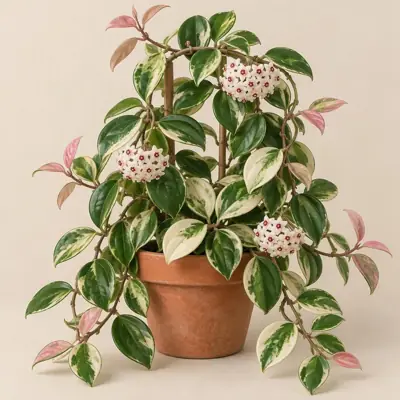
Sources differ on mature height, placing it at about 400–1000 cm; the few sources for mature spread report about 100–150 cm. Growth is vigorous, and as a houseplant it can grow rapidly and has been described as flowering earlier than other Hoyas. The opposite leaves are thick and fleshy to leathery, ranging from elliptical or ovate to nearly round; 'Lisa' has pinkish new leaves that mature with pale green and creamy-white variegation. The fleshy, waxy, white to creamy-white flowers have red markings at the center or beneath the corolla, are typically star-shaped and clustered, have a pronounced sweet fragrance, and can produce abundant nectar; sources differ on flowering season, with some reporting year-round flowering and RHS reporting flowering from late summer into autumn.
Light
Sources differ on light requirements: bright to bright filtered light, partial shade, or protection from direct sun during the hottest periods are recommended by some sources, while RHS lists full sun; ample light supports flowering.
Watering
Use a well-drained medium, water moderately, and avoid overwatering; water can be more plentiful during the growing season, while conditions should be drier or only slightly moist in winter, as the plant does not tolerate persistently wet soil.
Humidity and airflow
It is generally reported to prefer high humidity.
Temperature and dormancy
Sources differ on the reported USDA hardiness zones. It is generally reported to tolerate brief light frost.
Growing medium and mounting
Use a well-drained medium; loam or sandy soil can be used, while indoor plants can be grown in a well-draining potting mix, and another source recommends humus-rich, fertile soil that retains moisture without becoming waterlogged. RHS cultivation records include acidic, neutral, and alkaline conditions.
Propagation
Hoya australis can be propagated by cuttings, semi-ripe cuttings, layering, or seed.
Common problems
Common pests include aphids, mealybugs, scale insects, and spider mites, with RHS additionally listing glasshouse whitefly. Overwatering and poor drainage can cause root rot, although RHS describes the species as generally having few diseases. Insufficient light may also hinder optimal flowering. A sheltered growing position is preferred; houseplants can be moved outdoors in summer and brought back indoors as the weather cools, while some sources recommend shade from the most intense sun during the hottest conditions.
Identification
'Lisa' is distinguished most clearly by its variegated foliage: new leaves have pink tones and mature to pale green and creamy-white variegation, while retaining the thick leaves and fragrant, waxy, clustered flowers characteristic of Hoya australis.
Photos


Sources
- Wikipedia (en): Hoya australis — CC BY-SA 4.0 · link
- Wikipedia (de): Hoya australis — CC BY-SA 4.0 · link
- Wikipedia (es): Hoya australis — CC BY-SA 4.0 · link
- NC State Plant Toolbox: Hoya australis — copyright (facts only) · link
- LLIFLE Encyclopedia of living forms: Hoya australis — CC BY-SA · link
- Useful Tropical/Temperate Plants: Hoya australis — CC BY-NC-SA 3.0 (facts only) · link
- RHS Plants: Hoya australis — © RHS, facts only · link
- Top Tropicals catalog: Hoya australis — © Top Tropicals LLC (facts only) · link