
miniature wax plant (Hoya bella)
Hoya bella is a perennial evergreen epiphytic shrub or vine with slender, trailing stems and a cascading growth habit.
Watch: 21 Hoyas: Water Less, Wait Longer
Overview
Hoya bella is a perennial evergreen epiphytic shrub or vine with slender, trailing stems and a cascading growth habit.
Origin and habitat
Sources differ on its native range, which is described as extending from northeastern India to Myanmar. It is an epiphyte of tropical forests, growing on trees or branches; some accounts also describe attachment to trees and rocks by clinging roots. It favors warm, humid tropical conditions.
Characteristics
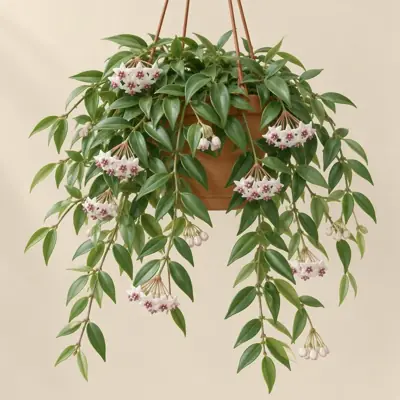
Sources differ on mature height, with the limited information suggesting about 10–50 cm; mature spread is reported from a single source as about 10–50 cm. The opposite, short-stalked leaves are fleshy or semi-succulent, ranging from lanceolate-ovate to oblong, with pointed tips, rounded bases, glossy dark-green upper surfaces, and paler, duller undersides. The hanging, umbel-like flower clusters bear fragrant, star-shaped flowers with mainly white corollas and pink, pale purple, or purple central coronas; it flowers in summer and may produce flower clusters repeatedly during warm periods. The fruit is reported to be elongated and pointed, and growth is generally reported to be slow.
Light
Sources differ on light guidance: bright filtered or indirect light is favored, while direct sun in the early morning or evening may aid flowering, and intense direct light that can scorch the leaves should be avoided.
Watering
Water moderately in a well-drained medium, allowing it to become nearly dry before watering again; avoid both waterlogging and prolonged excessive dryness, and reduce watering in winter while keeping the medium slightly moist.
Humidity and airflow
Hoya bella is reported to prefer moderate humidity, with limited information suggesting about 50–60 %, and it is also reported to need good airflow.
Temperature and dormancy
Sources differ on its reported USDA hardiness zone. It is reported to be frost tender; keep above freezing.
Growing medium and mounting
Use a loose, well-drained potting medium; a loam-based medium can be combined with sand, bark, or charcoal to improve drainage and aeration, and the medium may range from acidic through neutral to alkaline.
Propagation
Hoya bella can be propagated from stem cuttings; NC State recommends stem cuttings in spring and summer, while RHS also lists semi-ripe cuttings and layering.
Common problems
Possible pests include mealybugs, scale insects, and spider mites. Poor drainage or overwatering can cause root rot, while RHS describes the plant overall as generally having few disease problems. A single source reports that overwatering or poor drainage can cause root rot and yellowing leaves, sudden changes in temperature or light can cause leaf drop, intense direct sunlight can scorch leaves, and insufficient light can result in weak growth with elongated internodes. It is sensitive to frost and low temperatures, and cold drafts and freezing conditions should be avoided.
Identification
Hoya bella is relatively compact, with slender naturally trailing stems densely clothed in small, fleshy, pointed leaves; its hanging flower clusters have white star-shaped corollas, conspicuous pink-to-purple central coronas, and a sweet fragrance that is especially noticeable in the evening and at night.
Photos


Sources
- Wikipedia (en): Hoya bella — CC BY-SA 4.0 · link
- Wikipedia (de): Hoya bella — CC BY-SA 4.0 · link
- NC State Plant Toolbox: Hoya bella — copyright (facts only) · link
- Wikipedia (nl): Kleine wasbloem — CC BY-SA 4.0 · link
- RHS Plants: Hoya bella — © RHS, facts only · link
- Top Tropicals catalog: Hoya bella — © Top Tropicals LLC (facts only) · link